ACING INTERVIEWS V: Sharing & Applying Interview Insights
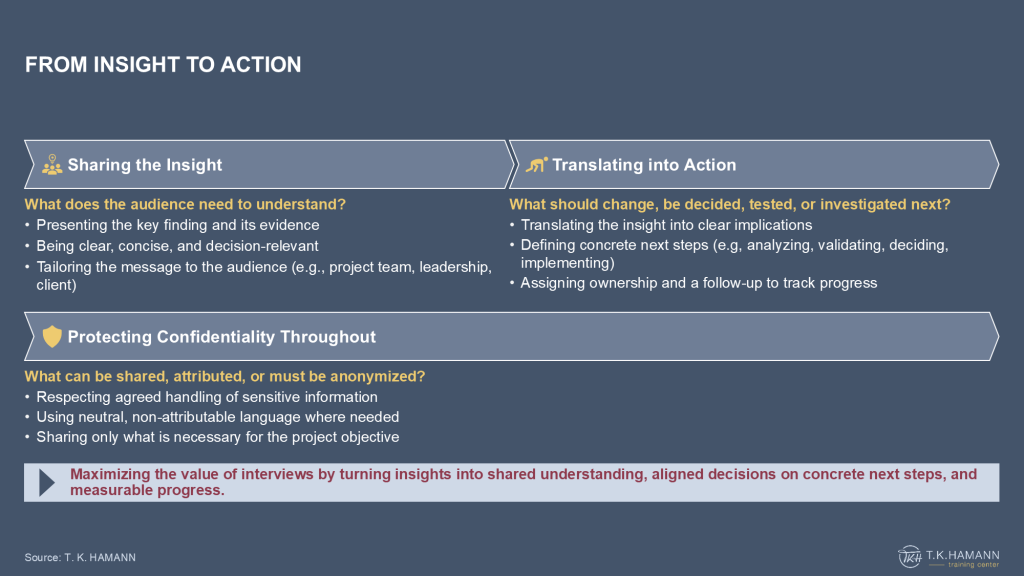
As Exhibit 1 shows, Sharing & Applying Insights is the fourth phase of the interview process. At this stage, the focus shifts from developing and testing insights to making them useful to others. The project team must communicate the findings in a clear, relevant, and appropriate manner for the intended audience while maintaining confidentiality and preserving the basis of the conclusions. The objective is not only to share what was learned but also to ensure that relevant insights inform decisions, further analysis, solution development, and implementation.
“How co we turn interview evidence into collective project knowledge and action?” The ultimate value of interview documentation lies in its transformative power. Before an interview, useful knowledge may only exist in the minds of production supervisors, customers, engineers, sales representatives, suppliers, senior executives, and other stakeholders. During the interview, some of that knowledge becomes accessible to the interviewer. Through disciplined documentation and synthesis, this knowledge becomes accessible to the project team. Finally, through analysis and application, the knowledge can influence project decisions and organizational action.
This progression can be summarized as follows: Individual knowledge → conversation → documented evidence → synthesized insight → project decision
Each step in this process is important. For example, if the wrong person is interviewed, relevant knowledge may remain undiscovered. If the interview is poorly conducted, that knowledge may not be articulated accurately. If the conversation is not well documented, important information may be lost. If findings are not synthesized, patterns and relationships may remain hidden. Even a well-conducted interview may ultimately have little impact if the resulting insights are not integrated into the project’s problem-solving process.
Therefore, the final challenge is to ensure that interview insights do not remain with the individual interviewer. They must be communicated in a way that allows the project team to understand the underlying evidence, challenge interpretations, and incorporate relevant findings into their collective thinking. At the same time, this sharing must respect the confidentiality commitments made to interviewees and preserve the evidential status of the information as it moves from interview notes to project discussions, analyses, and management presentations.
Ultimately, documentation and synthesis are not ends in themselves. They are meant to improve the quality of subsequent problem-solving and decision-making processes. Some interview insights will strengthen or weaken existing hypotheses. Others will identify the need for additional analyses, new interviewees, implementation risks, or possible solutions. Some insights will require further verification, while others may ultimately be rejected because stronger evidence points elsewhere. Therefore, the following sections address how to share insights rather than raw interview material, how to protect confidentiality when communicating findings, and how to convert relevant insights into action.
1 Sharing Insights, Not Interview Dumps
After the interviews have been documented, the next challenge is sharing the findings with the project team.
A common but ineffective approach is to circulate lengthy interview notes or transcripts and expect each team member to read them. While this method transfers information, it does little to create a shared understanding.
The project team usually needs synthesized insights rather than raw interview material. A useful synthesis distinguishes between an emerging finding, the supporting evidence, its implications, and remaining questions. This same structure provides a useful communication format for sharing interview insights with the broader project team because it conveys the conclusion without detaching it from the supporting evidence and associated uncertainties. This enables the project team to work with synthesized insights instead of having to reconstruct them from lengthy interview notes or transcripts.
This structure communicates the insight and the evidence behind it. It also distinguishes what the team believes it has learned from what still needs to be investigated. Sharing insights in this way allows the project’s collective thinking to be influenced by interviews rather than interviews remaining a source of knowledge held by individual interviewers.
2 Protecting Confidentiality When Sharing Findings
The confidentiality arrangements established before the interview continue to govern how the findings may be shared afterwards. Therefore, synthesis creates an additional responsibility: protecting the commitments made to interviewees.
Synthesis creates an additional responsibility: protecting the commitments made to interviewees. If the interviews were conducted on a non-attributable basis, the project materials should not contain details that could indirectly identify the source. Simply removing a person’s name may not be sufficient if the description makes it obvious who provided the information. For example: “The only plant manager who opposed the restructuring believes…” is hardly anonymous, even if the person’s name is omitted.
Particular care is required when sharing provocative quotations. While a memorable statement can strengthen a presentation, it can also damage trust if colleagues can easily identify who said it. The project team’s desire for compelling communication should never override the conditions under which information was provided.
At the same time, confidentiality should not be used to make mysterious claims that cannot be scrutinized. Statements such as “People are saying…” or “We heard that…” provide little analytical value. Even when attribution is restricted, the team should describe the evidence as precisely as possible. For example, they should indicate how many interviews support a theme and which broad stakeholder groups were represented.
3 Converting Insights into Action
Applying interview insights involves translating relevant findings into implications for the project’s future decisions and activities. The objective is not to act on every interview statement, but rather, to determine how well-supported insights should influence the project’s evolving understanding of the problem, its hypotheses, analyses, solution development, and implementation. In this sense, application is when interview evidence begins to shape the project team’s next steps.
Therefore, every important finding from an interview should trigger the question: “So what?”
- “Does the finding strengthen or weaken a hypothesis?”
- “Does it suggest an additional analysis?”
- “Does it identify another person who should be interviewed?”
- “Does it reveal an implementation risk?”
- “Does it change the team’s understanding of the problem?”
- “Does it point toward a possible solution?”
- “Does it require immediate action?”
Imagine an interview in which several employees report that customers often provide incomplete order information. Simply documenting this observation adds little value. The project team must determine the next steps. For example, they could analyze transaction data to quantify the frequency of incomplete orders. The order form may need to be revised. Customer interviews could explore why information is omitted. These findings may support the hypothesis that poor input quality causes downstream rework.
The movement from evidence to action is rarely direct. A finding from an interview may first lead to a revised hypothesis, additional analysis, another interview, or a different source of evidence before influencing a managerial decision. Therefore, applying an insight does not mean converting every finding immediately into a recommendation. Rather, it means ensuring that relevant evidence informs the project’s next best step.
This completes the fourth element of the interview process introduced at the beginning of this chapter: Preparing → Conducting → Documenting → Applying
In this context, “applying” means deliberately incorporating relevant insights into the broader problem-solving process. Depending on the finding, this may entail refining a hypothesis, directing further data collection, influencing solution design, identifying an implementation concern, or ultimately rejecting an interpretation if stronger evidence suggests otherwise. The project team, not the interviewee, is responsible for drawing conclusions and deciding what to do next.
In this way, interviewing becomes more than a conversation: It becomes part of the broader evidence base through which the project team solves the business problem.
4 Conclusion
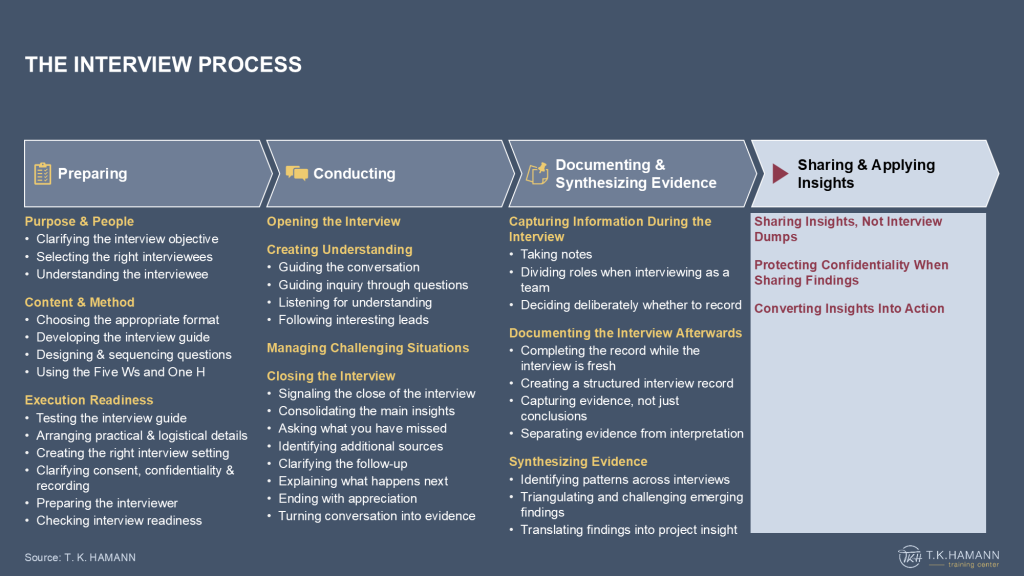
Together, the three activities discussed in this section comprise the final stage of the interview process. It is crucial to communicate interview insights in a way that helps the relevant audience understand the findings and their evidential basis while protecting confidentiality throughout. Insights are valuable only when they inform decisions, tests, further analyses, or implementations. As Exhibit 2 illustrates, sharing and applying interview insights means transitioning from understanding to purposeful action while maintaining evidential discipline and responsible handling of sensitive information.