ACING INTERVIEWS IV: Documenting & Synthesizing Interview Evidence
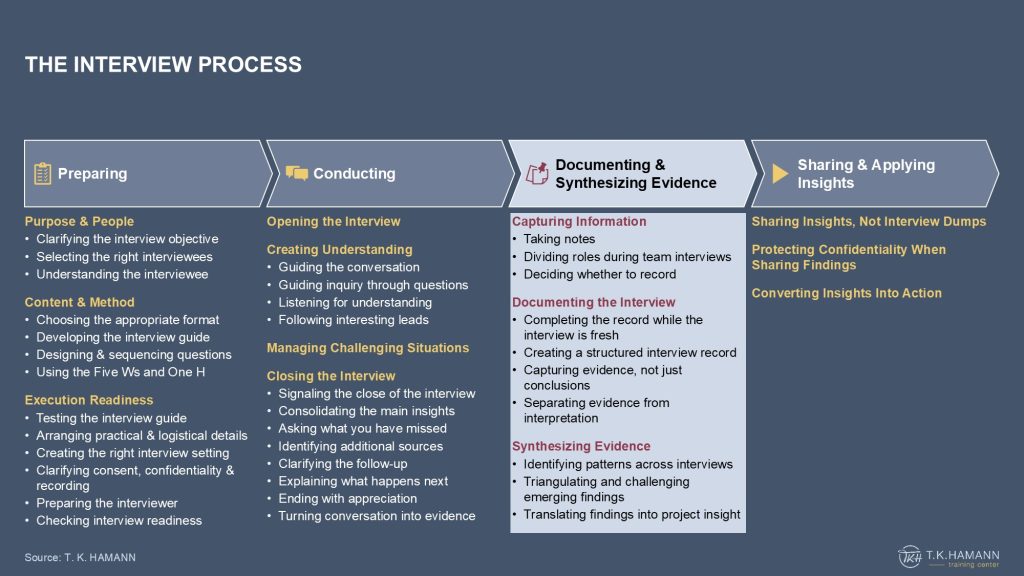
As Exhibit 1 shows, Documenting & Synthesizing Evidence is the third phase of the interview process. After preparing the inquiry and conducting the conversation, the focus shifts from generating information to preserving, assessing, and combining what has been learned. This phase begins by capturing information during the interview, continues by creating a reliable record afterward, and culminates in identifying patterns, triangulating emerging findings, and translating them into project insights.
A successful interview can foster a strong sense of understanding. Immediately afterward, the interviewer may vividly remember the discussion: the examples, nuances, moments of hesitation, and unexpected insights that seemed to explain important aspects of the problem. However, this creates a dangerous illusion—the belief that the information has already been captured simply because it is still fresh in the interviewer’s mind. It has not.
Unless the relevant information is systematically documented, much of its value will disappear. Details will be forgotten, interpretations will merge with recollections, and insights that seemed obvious immediately after the interview may be difficult to reconstruct several days later. This risk increases when a project team conducts dozens of interviews over several weeks. Documentation transforms a temporary conversation into a durable project asset.
However, documentation is not merely transcription. The objective is not to reproduce every word spoken. In most business projects, the goal is to capture the information necessary to understand the problem, test hypotheses, identify patterns, develop solutions, and support implementation. Thus, good documentation must be both accurate and selective.
1 Capturing Information During the Interview: How Do We Preserve Evidence Without Losing the Conversation?
Capturing information during an interview requires striking the right balance. The interviewer must preserve enough of the conversation for later analysis, all while remaining present enough to listen, probe, and respond to the interviewee. Insufficient documentation risks losing important facts, examples, wording, and open questions. However, too much attention to note-taking or recording can weaken the interaction and make the interview feel mechanical. Therefore, the objective is not to document everything, but rather to capture the information that matters without disrupting the quality of the conversation. The following sections explain how to achieve this balance through effective note-taking, deliberate division of roles, and thoughtful use of recording devices.
1.1 Taking Notes Without Losing the Conversation
Note-taking creates an inherent tension. The interviewer needs a record of the discussion yet must also be present in the conversation. An interviewer who spends most of the interview looking at a laptop screen may capture many words while missing their meaning. The interviewee may also perceive the interaction as mechanical or feel uncertain about what is being recorded. At the other extreme, relying entirely on memory creates unnecessary risk.
The appropriate balance depends on the interview. In many business settings, taking concise notes during the conversation is sufficient. The interviewer records key facts, figures, examples, important wording, open questions, and potential follow-up items. These notes are then expanded upon immediately afterward.
1.2 Dividing Roles When Interviewing as a Team
When two project team members participate, they can divide the roles. One person can lead the interview while the other focuses more on documentation and occasionally asks follow-up questions. This arrangement works particularly well for important or technically complex interviews. However, additional interviewers should serve a clear purpose. Surrounding an interviewee with a large project team can unnecessarily alter the atmosphere of the conversation.
A useful rule is that note-taking should support listening, not compete with it.
1.3 Deciding Deliberately Whether to Record
Recording an interview can improve accuracy. It allows the team to revisit exact wording, resolve uncertainties, and create a more complete transcript, if necessary. Therefore, recording can be valuable for particularly complex interviews, formal research, or conversations in which precise statements matter.
However, recording is not necessarily better than note-taking. People may communicate differently when they know that every word is being recorded. This can be particularly relevant in sensitive projects involving restructuring, performance problems, organizational conflicts, or politically contentious decisions. A recording that produces a perfect transcript but results in a guarded conversation may ultimately provide poorer evidence than concise notes from a candid discussion. Therefore, the decision should balance analytical requirements against the effect on the interaction.
Interviews should never be recorded without the explicit permission of the interviewee. The interviewer should explain why recording would be useful and how the recording will be handled. If the interviewee is uncomfortable, this preference should normally be respected, unless formal requirements dictate otherwise.
Recording also creates responsibilities after the interview. Audio or video files may contain confidential business information or personal data, so they should be stored, accessed, retained, and eventually deleted in accordance with applicable organizational policies and legal requirements. The availability of recording and automated transcription technologies does not eliminate these responsibilities. While technology can simplify documentation, it does not replace professional judgment about what should be recorded, retained, shared, or trusted.
2 Documenting the Interview Afterwards: How Do We Turn a Temporary Conversation into a Reliable Record?
The task changes once the interview ends. the conversation, the priority is to listen, understand, and capture the most important information without disrupting the interaction. Afterwards, the objective is to transform those incomplete notes and impressions into a reliable record that can support subsequent analysis. This requires more than simply typing up what was written down. The interviewer must complete the record while the context is still fresh. They must also preserve the information and examples that support emerging findings. They must distinguish what was stated or observed from subsequent interpretation. Finally, they must document uncertainties or follow-up needs. Therefore, a good interview record is neither a transcript nor a collection of conclusions. Rather, it is a structured and traceable account of the information generated through the interview. This account is designed to remain useful even after the conversation itself has ended.
2.1 Completing the Record While the Interview Is Fresh
The best time to document an interview is right after it ends. During the interview, the interviewer usually takes notes unless the conversation is recorded or another team member is assigned to document it specifically. While these notes are valuable, they are rarely complete. During the interview, attention should primarily remain on the interviewee rather than on producing perfect documentation.
For this reason, experienced project teams often set aside ten or fifteen minutes after important interviews to review and finish their notes. This small investment can substantially improve the quality of the information retained. Immediately after an interview, the interviewer remembers why a comment seemed important, what an abbreviated note meant, and which statements seemed especially credible or uncertain. Several hours later, much of this context may have disappeared. Consider the following handwritten note: “Approval—3 days? Only export orders—check.” Immediately after the interview, the interviewer would remember that the interviewee said export orders require an additional three days for separate approval but was unsure if this applies to all export markets. However, two days later, the same note may be almost meaningless.
The principle is simple: Capture first, rely on memory last. This does not mean creating lengthy transcripts after every conversation. It means documenting while the context is still fresh enough to distinguish what was said, what was inferred, and what still needs to be verified.
2.2 Creating a Structured Interview Record
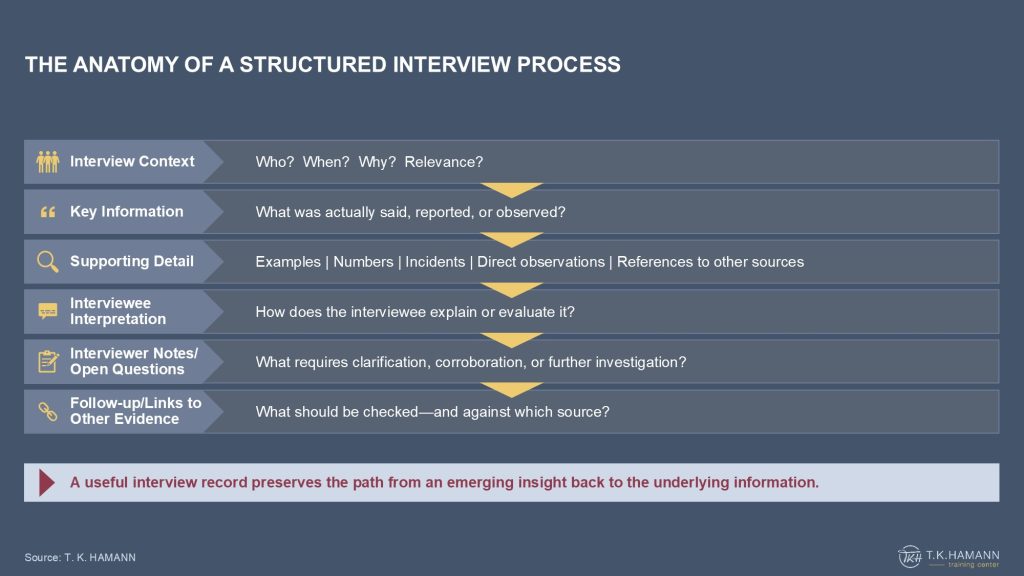
A useful interview record should be organized in a way that allows someone who was not present during the conversation to understand what was discussed, what information is important, and what still requires clarification or verification. The goal is not to transcribe the interview verbatim. Rather, the goal is to create a concise yet complete record that preserves the necessary information for subsequent analysis. A practical interview record may include the objective of the interview, the interviewee and their role, the date, the participants, the key topics discussed, the relevant factual claims, the reported experiences and opinions, the examples, the important quotations, the open questions, the references to documents or data, and the agreed-upon follow-up actions. Organizing notes around the interview objective, major themes, or current hypotheses can make comparison across interviews considerably easier later.
A good record should also capture more than spoken words when additional context is relevant to understanding the conversation. For instance, the interviewer may note when an answer is uncertain, when a figure cannot be confirmed, when a particular example refers only to one site or customer segment, or when an important statement is based on secondhand information rather than personal experience. Relevant contextual observations may also include unusual hesitation, a marked change in tone, or an issue the interviewee repeatedly found difficult to address. These signals should not be considered evidence of hidden motives or analyzed using amateur psychology. They indicate uncertainty, sensitivity, or areas that may warrant further clarification.
The same principle applies to supporting material. If an interviewee refers to a report, process document, system extract, customer case, or other source, the record should capture that reference so the project team can follow up on it later. Likewise, unresolved questions and commitments should be explicitly documented rather than left in the interviewer’s memory.
Therefore, the objective is not to create the longest possible record, but rather, the most useful one. A structured interview record should preserve enough context to make the information understandable and traceable, all while remaining focused on what is relevant to the project’s information needs.
Exhibit 2 summarizes these principles in a practical structure. A useful interview record should reveal the context in which information was provided, the information itself, the supporting details, the interviewee’s interpretation, and any remaining questions. It should also indicate what requires follow-up or comparison with other evidence. When structured this way, the record preserves the path from emerging insights to underlying information, providing a reliable basis for later triangulation, synthesis, and project judgment.
2.3 Capturing Evidence, Not Just Conclusions
Project teams are often tempted to only document the conclusions they draw from an interview. For example: “The procurement process is too slow.” While concise, this statement is analytically weak because it provides no basis for the conclusion. A stronger note might read: “The interviewee reports that purchase requests above USD 50,000 require three sequential approvals. In two recent examples, requests waited four and six working days, respectively, for the second approval.” This formulation preserves the underlying information so that it can be assessed later, compared with other sources, and verified where necessary.
Concrete examples are particularly valuable. When interviewees describe specific events, decisions, customer situations, or process failures, these examples preserve the context in which an issue manifests itself. They also help project team members who did not attend the interview understand why a finding may matter.
Direct quotations can be useful as well, particularly when the wording captures an organizational attitude, stakeholder concern, or customer perspective especially well. However, quotations should be used selectively, in accordance with the confidentiality arrangements established for the interview. The objective is not to collect memorable sound bites. Rather, the goal is to preserve enough supporting information so that an emerging insight can be traced back to what was said or observed.
2.4 Separating Evidence from Interpretation: What Do We Know—and What Do We Infer?
One of the most important principles of interview documentation is distinguishing between the information collected during an interview and the subsequent interpretations and conclusions derived from it. High-quality interview notes carefully distinguish between what was observed or stated, what the interviewee believes it means, and what the interviewer or project team infers. These distinctions may appear subtle, but they are fundamental to analytical rigor. Failing to make these distinctions creates a serious risk: An interviewee’s interpretation—or even the project team’s inference—may gradually acquire the status of a fact simply because it has been recorded in a formal project document.
A useful starting point is a simple principle: What an interviewee tells us is information. The evidence that information provides must be assessed.
Effective listening requires interviewers to distinguish between observed or stated information and their interpretation of it. This distinction becomes even more important when the interview is documented. Therefore, one of the most important principles of interview documentation is distinguishing between the information collected during an interview and the subsequent interpretations and conclusions derived from it:
- A factual claim is a statement about a matter that can potentially be verified. Such matters include dates, process steps, organizational responsibilities, quantities, and measured values. The term “factual claim” is more precise than simply calling such a statement a “fact.” For example, if an interviewee states that an approval takes five working days, the interview establishes that the interviewee made this claim. However, it does not establish that the average approval time is actually five days. Workflow data, documents, observations, or other sources may be necessary to verify the claim.
- Reported experiences describe what interviewees say they have personally observed or encountered. These accounts can provide valuable firsthand information about how processes operate, how decisions are made, and how problems manifest in practice. However, a reported experience does not necessarily establish how representative the experience is. For example, an employee who regularly encounters incomplete customer orders may accurately describe his or her experience, but this does not demonstrate that incomplete orders are a widespread problem across the organization.
- Opinions express judgments, preferences, evaluations, and beliefs. They can be important information in an interview, particularly when stakeholder perceptions, attitudes, or preferences are relevant to the project. However, an opinion should not be treated as evidence that the object of the opinion is objectively as described. For example, if a sales manager says, “Our customers care much more about price than service quality,” the interview reveals the sales manager’s beliefs about customer priorities. To establish what customers actually value, one may need to conduct customer interviews, analyze survey data and purchasing behavior, and perform win/loss analyses.
Distinguishing between factual claims, reported experiences, and opinions helps preserve the evidential status of the collected information. This enables the project team to ask, “What can we actually conclude from this information, and what still needs to be verified?” rather than simply, “What did we hear?”
A second distinction becomes necessary when the interviewee begins to explain the provided information. “Interviewee interpretation” refers to the meaning or explanation an interviewee gives to an observation, experience, or other information. For example, an interviewee might report that approval times have increased and attribute the increase to the addition of a new management layer. These are two different pieces of information: The interviewee reports an observed development and offers an explanation for it. While the proposed cause may be entirely plausible, it should not automatically be given the same evidential status as the underlying observation.
Another distinction is necessary when the project team begins to make sense of what they have heard. “Project team inference” refers to the conclusion that the interviewer or team draws from the collected information. Such inferences are an essential part of problem-solving; information has limited managerial value unless the team considers its potential meaning for the problem under investigation. However, the inference should be distinguishable from the underlying interview information and the interviewee’s interpretation. Otherwise, the project team risks unconsciously converting its emerging explanations into established facts.
Consider an interviewee who says: “Since the new system went live, I’ve spent an extra hour each day correcting orders.” This statement should not be taken at face value: “The new system reduces productivity by one hour per employee per day.” The interviewee reported a personal experience and provided an estimate. While the statement may be highly relevant, several questions remain unanswered: “Is the additional effort really caused by the new system?”, “Do other employees experience the same problem?”, “Is one hour a representative estimate?”, “What types of errors require correction?”, “How much additional workload does the problem create across the entire process?” A disciplined project team could capture and develop the findings as follows:
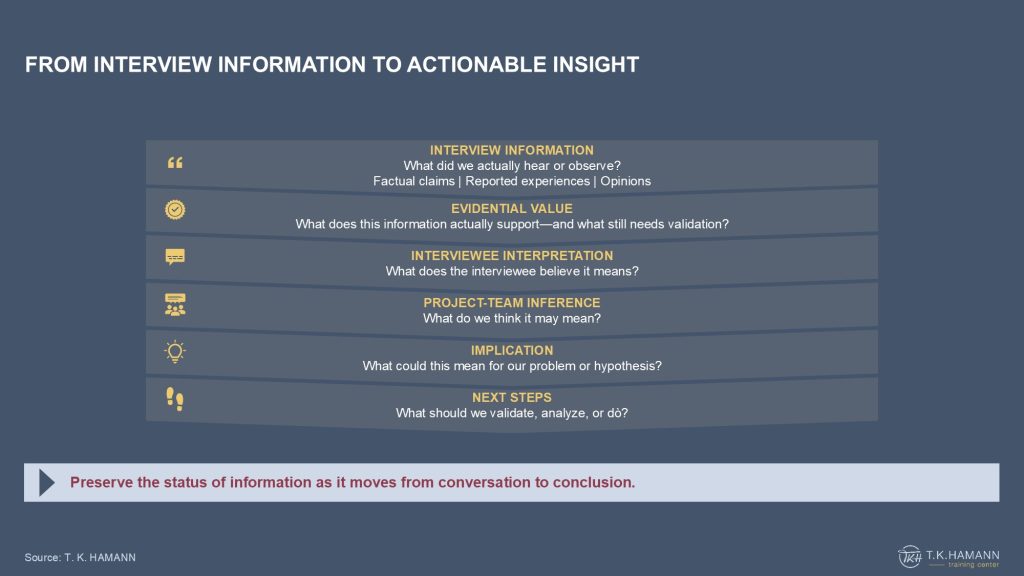
- Interview information—reported experience: The interviewee estimates spending approximately one additional hour per day correcting orders since the new system was introduced.
- Evidential Value: What does this information support? How reliable is that support? What still requires validation or corroboration?
- Interviewee interpretation: The interviewee attributes the additional correction effort to the new system.
- Project-team inference: Order-data quality or system design may be creating significant additional workload.
- Implication: If the observation is representative, the issue could materially affect process productivity and warrant further investigation.
- Next step: Analyze error frequency and correction effort using transaction data, additional interviews, or direct observation.
Progression is important. Interview information provides the starting point. Then, its evidential value must be assessed: “What does the information actually support, and what remains uncertain?” The interviewee may offer an interpretation, and the project team will develop its own inference. That inference may have implications for the business problem, which will help determine what should be investigated or done next. As illustrated in Exhibit X, this process creates a disciplined path from an individual interview statement to a potentially actionable project insight, clearly distinguishing between original information and interpretation.
The key is to preserve these distinctions as the information moves through the analytical process. An interview statement should not become a project conclusion simply through repetition or familiarity. Each step should explicitly state what is known, what has been interpreted, what has been inferred, and what still requires validation. Exhibit 3 illustrates this progression, demonstrating how interview information can be developed into actionable insights while maintaining its original evidential status.
A project team’s inference may subsequently become—or lead to the modification of—a hypothesis: A provisional explanation that should be tested against further evidence. Therefore, an interview may strengthen, weaken, or replace an existing hypothesis, or reveal an entirely new avenue of investigation. The important thing is that the hypothesis remains recognizable as such until sufficient evidence supports a stronger conclusion. This distinction is particularly important in hypothesis-driven problem solving. Hypotheses should guide the search for evidence and not become evidence themselves.
The same discipline should be maintained as findings evolve beyond the initial interview notes. A carefully qualified observation can easily become more definitive when summarized in a team discussion, transferred to an analysis, and eventually condensed onto a management slide. “One interviewee estimates spending an additional hour correcting orders” can gradually become “Employees spend an additional hour correcting orders” and finally “The new system causes one hour of lost productivity per employee.” Each formulation appears only slightly stronger than the previous one, yet the final statement claims considerably more than the original information supports. Maintaining the evidence trail helps prevent this gradual erosion of analytical precision.
This leads to a simple but important principle: Capture first, interpret second. Immediately after the interview, the priority is to accurately preserve what was said, observed, and agreed upon. Interpretation and synthesis should follow, but they should not rewrite the underlying evidence silently. Consequently, the project team should assess the evidential value of the information before interpreting, synthesizing, and developing hypotheses. These activities are essential for turning interview information into project insight, but they should never alter the underlying information or make it appear more conclusive than it actually is.
Therefore, interview information should always be considered considering its limitations. This includes who provided it, their position and experience, the degree of certainty, and where interpretation begins to extend beyond what was stated or observed.
3 Synthesizing Evidence Across Interviews: How Do We Move from Individual Accounts to Project Insights?
The value of interviews increases considerably when the conversations are analyzed together. A single interview only provides one perspective. Ten interviews may reveal patterns.
Synthesis is the process of combining information from multiple sources to gain a more comprehensive understanding than any single source can offer. In interview-based project work, synthesis involves identifying recurring themes, meaningful differences, contradictions, unusual observations, and relationships among findings. The following sections outline three related analytical tasks: identifying patterns, testing emerging findings through triangulation, and synthesizing the resulting evidence to create project insights.
3.1 Identifying Patterns Across Interviews
After several interviews have been completed and documented, the analytical focus shifts from individual conversations to the body of evidence. Rather than asking, “What did this interviewee tell us?” the project team increasingly asks, “What are we seeing across interviews?” At this point, recurring themes, meaningful differences, and potential relationships among findings begin to emerge.
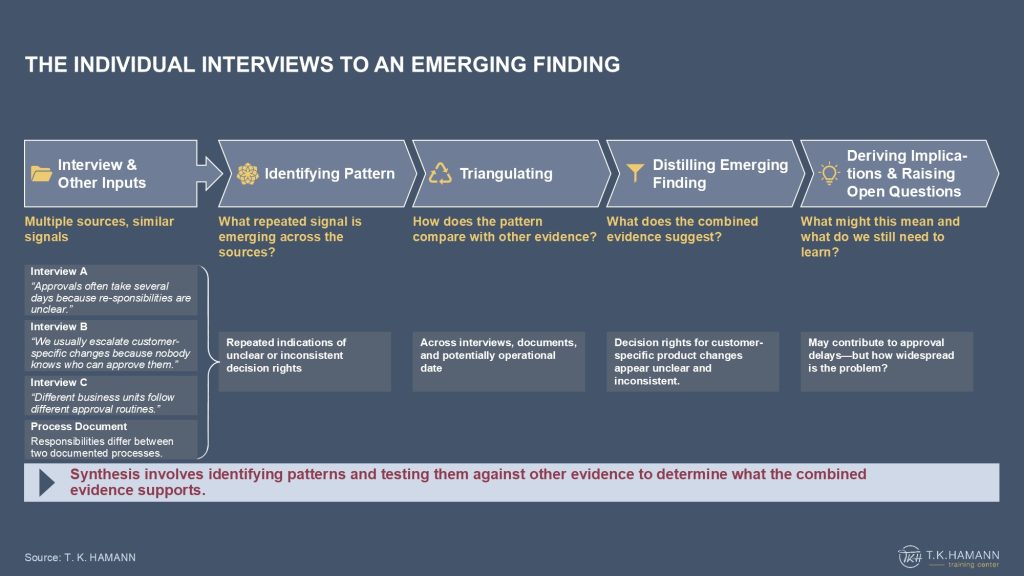
Patterns emerge when similar signals recur across interviews or when interview information aligns with other sources. However, recurrence alone does not constitute a robust finding. As Exhibit 4 shows, the analytical process involves identifying repeated signals, triangulating them with other evidence, distilling an emerging finding, and considering its implications and remaining questions. This progression ensures that the synthesis reflects the combined evidence rather than the repetition of individual statements.
A pattern is a recurring or systematically varying observation across multiple interviews or sources. These patterns may consist of similar experiences reported independently by several interviewees, repeated references to the same process weakness, consistent differences between organizational units, or observations that appear to occur under similar circumstances. Patterns do not mean that everyone says the same thing. A recurring difference can be a pattern itself—for example, if managers consistently describe a process as standardized, while employees in different locations describe substantially different local practices.
A practical starting point is to organize interview information around common themes that reflect the project’s information needs. Depending on the problem, these themes may include decision-making, roles and responsibilities, processes, systems, customer requirements, organizational interfaces, performance barriers, or implementation challenges. Existing hypotheses can provide an initial structure, but they should not become a rigid coding scheme. New themes may emerge from the interviews and should be added when they help explain the problem more effectively.
The project team should then compare findings within and across these themes:
- “Which issues appear repeatedly?”
- “Which seem confined to a particular function, location, customer group, or level of the organization?”
- “Where do several observations appear to describe different manifestations of the same underlying problem?”
- “Where does one interview reveal an exception that challenges what otherwise seems to be a common pattern?”
For instance, imagine that the Engineering department reports frequent changes in requirements, the Marketing department describes customer needs being clarified too late, the Procurement department points to suppliers being involved only after major design decisions have been made, and the project managers complain about delayed approvals. Viewed separately, these issues may appear to be distinct functional problems. However, viewed across interviews, they may suggest a broader pattern: important decisions and commitments are repeatedly postponed until late in the development process.
This step requires judgment. Repetition alone does not make a pattern significant, and frequency should not be confused with evidential strength. An idea expressed by many interviewees may still be based on the same assumption, rumor, or shared organizational narrative. Conversely, an observation raised by only one interviewee may be highly significant if that person has direct access to relevant information or identifies an issue that can be verified. Therefore, pattern identification primarily serves to determine what deserves closer examination, not what should be accepted as true.
Useful pattern analysis pays attention to absence and variation. For example, if an issue is repeatedly mentioned in one business unit but never in another, the difference may help isolate its causes. If a process problem occurs only under customer conditions, product types, or workload levels, the variation may be more informative than the overall frequency of the complaint. Looking for such differences helps the team move from broad observations toward more precise explanations.
The output of this step should be a set of emerging findings rather than final conclusions. These findings capture recurring, distinctive, or potentially explanatory themes across the interviews and indicate where further analysis is warranted. The findings provide input for the next step, which is to assess how strongly the emerging findings are supported by comparing sources, examining corroborating evidence, and investigating contradictions.
3.2 Triangulating and Challenging Emerging Findings
Triangulation is the deliberate comparison of information from multiple independent sources, methods, or perspectives to assess and strengthen an emerging finding. In interview-based project work, for example, it may involve comparing what different interviewees report with documents, transaction data, observations, surveys, or other available evidence.
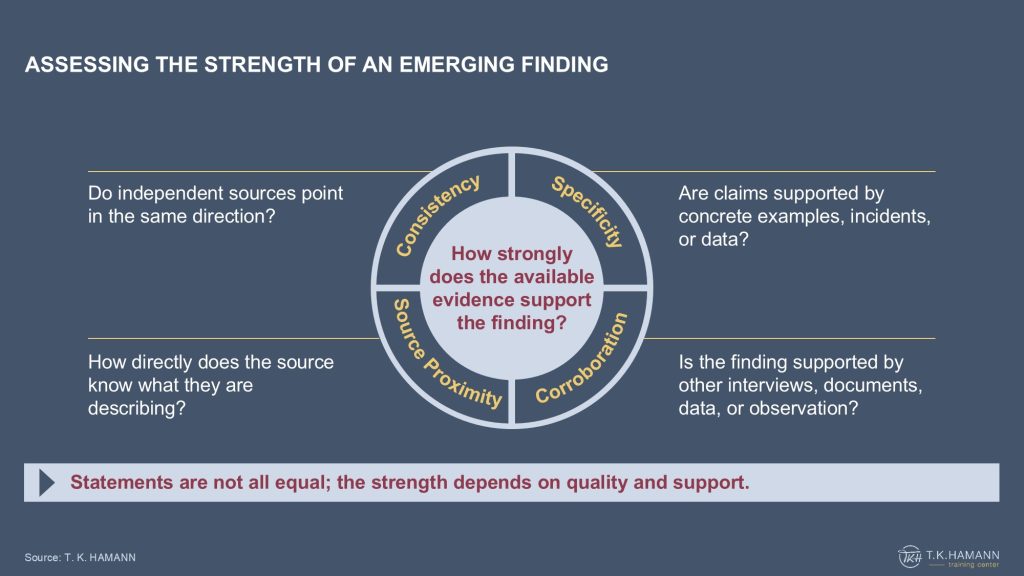
Therefore, triangulation involves more than determining whether several sources appear to agree. The project team must also evaluate the strength of the evidence supporting an emerging finding. As Exhibit 5 illustrates, the following four considerations are particularly useful:
- The consistency of independent sources
- The specificity of the supporting information
- The proximity of the source to what is being described
- Corroboration through other forms of evidence
Together, these dimensions help the team distinguish between a recurring assertion and a finding that is increasingly well supported.
Not every statement deserves equal weight. A finding that is reported independently by several interviewees, supported by concrete examples, and corroborated by quantitative data generally carries more weight than an isolated opinion expressed by one person. Therefore, project teams should evaluate emerging findings based on factors such as consistency, specificity, source proximity, and corroboration. This assessment becomes stronger when interview findings can be compared with other sources, such as documents, transaction data, observations, or additional interviews. Source proximity refers to how directly an interviewee is connected to the subject being discussed. For example, a warehouse employee who performs a process daily may provide stronger evidence of its operational reality than a senior executive who knows the process only in general terms. Conversely, the executive may be a stronger source for understanding why the process was designed a certain way. Therefore, organizational hierarchy and evidential strength are not the same. The appropriate question is always: “Who is in the best position to know this particular thing?”
This assessment becomes stronger when interview findings can be compared with other sources, such as documents, transaction data, observations, or additional interviews. Confidence in an emerging finding generally increases when several independent sources point toward the same conclusion. For example, suppose that employees in three departments independently report that unclear ownership contributes to approval delays. Process documentation reveals overlapping responsibilities, and workflow data show unusually long waiting times at the relevant handoff. Taken together, the interviews, documents, and quantitative data provide substantially stronger support for the finding than any one source could alone. This is triangulation in practice.
However, triangulation should not be understood as merely a search for agreement. Contradictions can be just as informative as convergence. For instance, if senior management believes a new process has been fully implemented, yet frontline employees report using the old process, the discrepancy may indicate an implementation gap. Similarly, if customers identify delivery reliability as their primary concern, but the sales organization believes price is the main issue, the contradiction may reveal a flawed internal assumption about customer priorities. Differences between sites operating under the same formal process may also point to local practices that result in different performance outcomes.
Therefore, such contradictions should be highlighted rather than averaged away. They do not necessarily mean that one source is right, and another is wrong. Different interviewees may observe different aspects of the same reality, use different definitions, operate under different local conditions, or interpret the same events from different organizational perspectives. In some cases, the contradiction itself may be the important finding.
The appropriate response is not to force premature agreement, but rather, to investigate the divergence. The project team should ask whether the sources are referring to the same phenomenon, what explains the difference, and what additional evidence could clarify the issue. This may require further interviews, quantitative analysis, document review, direct observation, or another method better suited to resolving the uncertainty.
Thus, triangulation serves two complementary purposes:
- Convergence increases confidence in an emerging finding.
- Divergence reveals areas where the project team’s understanding is incomplete.
Both are valuable. The objective is not to make all sources agree but rather to develop a progressively stronger and more nuanced understanding of the business problem by comparing perspectives, testing interpretations, and following the evidence wherever it may lead.
3.3 Translating Findings Into Project Insight
As discussed earlier, the project team first identifies recurring patterns and then tests emerging findings against the broader evidence base. Next, the team determines what these findings collectively mean for the business problem.
Synthesis involves more than summarizing individual interviews. A summary describes what one interviewee said. Synthesis, on the other hand, combines information from multiple interviews and other sources to develop a higher-order understanding that no single interview may provide on its own. Therefore, the analytical task shifts from “Who said what?” to “What does the combined evidence suggest?”
An emerging finding describes something the project team currently observes in the evidence, such as a recurring pattern, meaningful difference, or relevant relationship. A project insight goes one step further. It explains why the finding is important to the team’s understanding of the business problem while explicitly stating the supporting evidence and remaining uncertainties.
A useful way to structure this progression is to distinguish between four elements:
- Emerging finding: “What appears to be happening?”
- Evidence: “What information supports this finding?”
- Implications: “Why or in what ways does this finding matter for the business problem?”
- Open question: “What remains uncertain or requires further investigation?”
For example:
- Emerging finding: Decision rights for customer-specific product changes are unclear.
- Evidence: The issue was raised in seven of the nine relevant interviews and is supported by three recent examples. Formal responsibility differs across two process documents.
- Implication: Unclear decision rights may contribute to delayed approvals and repeated escalation.
- Open question: Is the issue company-wide or concentrated in select business units?
The distinction between finding and implication is important. The finding should be based on the evidence. The implication introduces analytical meaning by connecting the finding to the broader business problem. However, the implication should not claim more than the evidence allows. Words such as “may contribute to,” “appears to indicate,” or “is consistent with” can be appropriate when causal relationships have not yet been sufficiently established.
Effective synthesis also requires connecting findings that may initially appear to be separate. Several well-supported findings may jointly explain a broader mechanism, reveal an underlying cause, identify a critical constraint, or challenge the project team’s previous framing of the problem. In this sense, synthesis is not merely about compressing information. It is about developing a more coherent explanation of the situation from the available evidence. This distinction helps prevent two common mistakes:
- Synthesis does not become a mere collection of interview summaries, quotations, or isolated observations.
- It prevents the project team from presenting its interpretations as established facts. Strong project insights are traceable to the evidence from which they were derived and reveal remaining uncertainty.
Thus, the objective of synthesis is not to produce a shorter version of the interviews. Rather, synthesis transforms sufficiently supported emerging findings into a more coherent understanding of the business problem. Individual interviews provide perspectives, pattern identification reveals what may matter, triangulation tests how strongly the findings are supported, and synthesis determines what the combined evidence means for the project.