
ACING INTERVIEWS III: From Questions to Deeper Understanding
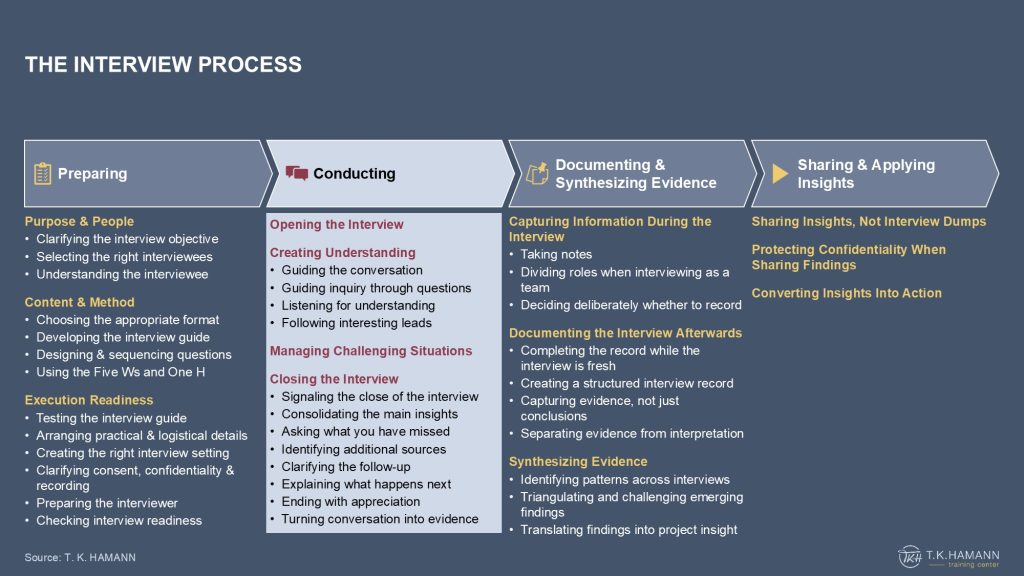
As Exhibit 1 shows, the second phase of the interview process is conducting. At this stage, preparation gives way to interaction. The interviewer must transform a planned inquiry into a productive conversation by opening the interview, guiding the discussion, asking purposeful questions, listening for meaning, following promising leads, managing difficult situations, and closing the conversation in a way that preserves what has been learned. The challenge is to maintain enough structure to stay focused while remaining flexible enough to let new information shape the conversation.
1 Opening the Interview: How Do We Create the Conditions for an Open and Productive Conversation?
The first few minutes of an interview often determine its overall quality. During this time, interviewees form impressions of the interviewer’s professionalism, credibility, intentions, and competence. Likewise, the interviewer begins to evaluate the interviewee’s communication style, openness, and knowledge of the subject.
Although a rushed introduction might save two minutes at the start of the meeting, it could cost twenty minutes later if the interviewee remains uncertain about the purpose of the conversation. Therefore, it is almost always worthwhile to invest a little time in establishing a professional atmosphere.
A typical opening should start by thanking the interviewee for participating. In business projects in particular, interviews compete with many other priorities. Acknowledging the interviewee’s willingness to participate demonstrates respect and establishes a positive tone.
The interviewer should then briefly introduce the project, explain the purpose of the interview, and clarify how the information will be used. Lengthy project presentations should be avoided. Most interviewees are primarily interested in understanding why they were invited and how their contribution will help. A concise introduction might sound as follows: “Thank you for meeting with us today. As part of our project, we are seeking to understand how customer orders are processed, from the initial request to the final delivery. We are particularly interested in learning from your experience as the process owner. Your perspective will help us better understand where delays occur and where improvements could be made.” This introduction explains the purpose without suggesting the desired answer.
Before the discussion begins, the interviewer should clarify practical aspects, such as the planned duration of the interview and whether notes or recordings will be taken. Clarifying these expectations at the outset reduces uncertainty and allows both parties to focus on the conversation itself. Only after this brief introduction should the interviewer begin asking substantive questions.
2 Creating Understanding: How Do We Guide the Conversation from Questions to Deeper Insight?
Creating understanding requires more than asking well-designed questions. During the interview, the interviewer must guide the conversation, listening for meaning, interpreting what is being said, probing for clarification, and following unexpected leads that could improve the project team’s understanding of the problem. This process is inherently iterative; each answer can shape the next question, challenge an existing hypothesis, or reveal an issue not anticipated during preparation. The following sections focus on maintaining direction without becoming rigid, using questions purposefully, listening analytically, and pursuing promising lines of inquiry without losing sight of the interview objective.
2.1 Guiding the Conversation
Many people imagine that interviews follow a perfectly linear sequence of prepared questions. In practice, however, this is rarely the case. Good interviews are dynamic. Interesting ideas emerge unexpectedly, explanations trigger new questions, and important insights often arise from topics that were not anticipated during preparation.
Therefore, rather than rigidly following the interview guide, the interviewer’s task is to guide the conversation toward the interview objective. Guiding does not mean controlling every aspect of the discussion. Rather, it means maintaining a clear sense of direction while remaining flexible enough to explore promising new avenues.
One helpful approach is to start broadly and then gradually move toward greater detail. For instance, rather than immediately asking, “Why do customer complaints increase after order confirmation?” the interviewer could start with: “Could you please walk me through the order fulfillment process from your perspective?” This allows the interviewee to describe the situation in his or her own words before the interviewer investigates specific issues in greater depth.
This progression from broad exploration to focused investigation is often called the funnel approach: Rather than beginning with detailed or potentially sensitive questions, the interviewer gradually narrows the conversation toward more specific aspects of the topic. This approach enables interviewees to provide context before discussing causes, opinions, or potential shortcomings. It also helps the interviewer identify unexpected issues that may warrant further exploration.
Throughout the interview, the interviewer should regularly assess whether the discussion is still contributing to the interview’s objective. Conversations occasionally drift toward interesting yet ultimately irrelevant topics. While such detours may strengthen rapport, they also consume valuable time. Therefore, a skilled interviewer knows when to encourage further exploration and when to gently redirect the conversation. Simple transition phrases often suffice. For instance: “That is very helpful. I’d like to return to something you mentioned earlier…” or “You raised an interesting point about supplier coordination. Before we explore that further, could we first finish our discussion of internal approval?“ These types of transitions help maintain focus during an interview without disrupting its natural flow.
The interviewer should also be mindful of time. If they spend half the interview on the first topic, there will often be insufficient time for equally important issues later. Periodically checking progress against the interview guide ensures that all essential topics are covered while allowing enough flexibility to pursue valuable insights as they emerge.
Thus, good interview guidance resembles good project management. It combines planning with adaptability, structure with flexibility, and clear objectives with openness to new information.
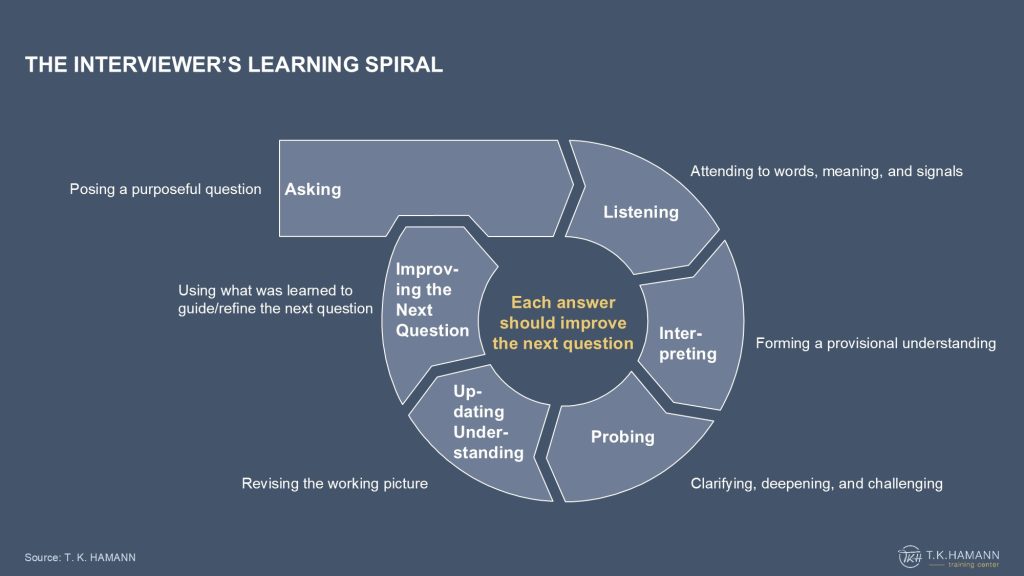
Therefore, effective interviewing can be understood as a recurring microcycle of questioning, listening, and synthesizing. The interviewer asks purposeful questions, listens for meaning, and reflects the emerging understanding back to the interviewee through clarification, paraphrasing, or synthesis. The response to this synthesis often generates the next, better question. Consequently, a high-value interview is less a sequence of questions and answers and more an iterative process of progressively improving understanding.
2.2 Guiding Inquiry Through Questions
Interviewers primarily use questions to generate information. However, the effectiveness of an interview depends far more on the quality and sequence of the questions than on how many are asked. A well-conducted interview is not an interrogation in which questions are asked one after another from a prepared list. Rather, it is a structured dialogue in which each question builds on the previous answer, gradually deepening the interviewer’s understanding of the subject.
For this reason, experienced interviewers focus more on the learning process they want to create than on the questions themselves. Every question should bring the conversation closer to answering the interview objective. If a question does not contribute to the objective, then it should probably be omitted. This principle requires discipline. Many inexperienced interviewers prepare twenty or thirty questions before the interview begins. During the interview, they feel obligated to ask every question on the list, regardless of how the conversation develops. The result is often an interview that feels mechanical and fragmented. Important insights remain unexplored because the interviewer is already thinking about the next question instead of listening carefully to the answer being given.
Professional interviewers take a different approach. They prepare topics rather than scripts. Their questions evolve as the conversation unfolds. While the interview guide provides direction, the path forward is determined by the interviewee’s responses.
2.2.1 Questions Should Support Thinking
The primary purpose of a business interview is not merely to collect information. Rather, it is to improve the project team’s understanding of the situation. Therefore, questions serve several purposes during an interview: Some questions establish facts. Others clarify processes. Some explore motivations. Some test assumptions or challenge emerging hypotheses. Still others encourage interviewees to reflect on possible improvements or future developments.
Recognizing these different purposes helps interviewers ask better questions at the right time. For instance, imagine a project team investigating declining productivity in a manufacturing plant. A factual question might be: “How many operators are normally assigned to this production line?” A process-oriented question could follow: “Could you walk me through what happens after a production order is released?” Once the interviewer understands the sequence of activities, the discussion may shift toward interpretation: “Which part of this process presents the greatest difficulty from your perspective?” Finally, the interviewer may test an emerging hypothesis, such as, “Several people have suggested that changeover planning is an important cause of the delays. How does that correspond with your experience?” Notice how the questions progress from objective description to interpretation and evaluation. This progression reduces the risk that the interviewer will jump too quickly to conclusions.
2.2.2 From Facts to Interpretations
One of the most common mistakes in business interviews is asking for an explanation before determining what happened. For instance, imagine an interviewer starts with the question, “Why is the approval process so inefficient?” This question assumes that the process is inefficient. It also requires the interviewee to interpret the situation before the interviewer and interviewee have agreed on the facts.
A more productive approach would be to first reconstruct the process. The interviewer could ask, “Could you describe what happens after a purchase request is submitted?” Once the process has been described, the interviewer could ask, “Which steps usually take the longest?” Only after the factual sequence is clear should the interviewer explore the underlying causes. “What typically causes these delays?” Finally, the discussion may turn toward possible improvements. “If you could change one aspect of the approval process, which would you change first?” This progression—from facts to interpretations and from interpretations to recommendations—produces richer information and reduces defensiveness. People generally find it easier to describe their actions than to explain why problems exist.
2.2.3 Building Questions Around Hypotheses
Professional problem solving is rarely an exploratory activity. Project teams continuously develop and refine hypotheses to guide their investigations. Interviews are no exception. A hypothesis provides direction without determining the outcome. It offers a potential explanation that must be tested against evidence. For instance, imagine that a project team hypothesizes that customer complaints primarily stem from inconsistent communication between the sales and production departments.
An inexperienced interviewer might ask, “Would you agree that communication between sales and production is the main problem?” This question encourages confirmation rather than learning.
An experienced interviewer would approach the same hypothesis differently. First, the interviewer would explore the broader context. They might ask, for example, “How do sales and production coordinate customer orders?” The answer may reveal communication problems—or something entirely different. Then, the interviewer can investigate further. They might ask, “Can you describe a recent example where coordination worked particularly well or poorly?” Only after collecting sufficient evidence should the interviewer explicitly test the hypothesis, such as, “Several interviewees have suggested that communication between the two departments could be improved. How important do you think this issue is compared to other factors?”
This approach allows the hypothesis to be examined without steering the interviewee toward a predetermined conclusion. Thus, good interviewers use hypotheses to guide their curiosity rather than to confirm their existing beliefs.
2.2.4 Asking Neutral Questions
One of the most important characteristics of an effective business interview is neutrality. Neutral questions do not imply that one response is preferable to another. They give the interviewee the freedom to describe the situation from his or her own perspective.
Compare the following questions: “Don’t you think the new approval process has become unnecessarily bureaucratic?” The wording implies that the process is bureaucratic. A more neutral alternative would be: “How has the new approval process affected your daily work?”
Similarly, “Wouldn’t automation solve most of these problems?” should be replaced with “What role do you think automation could play in addressing these issues?” Small differences in wording can significantly impact the responses received.
Neutral questions are especially important when interviewing senior executives or experts. These interviewees are often highly experienced communicators. They quickly recognize leading questions and may adapt their responses, either consciously or unconsciously, to what they think the interviewer wants to hear.
2.2.5 Encouraging Richer Answers
Not every useful question has to be complex. Often, the most valuable insights come from the simplest follow-up questions. Examples include:
- “Could you explain that in more detail?”
- “What happened next?”
- “Can you give me a concrete example?”
- “What makes that particularly difficult?”
- “How often does this occur?”
- “Who else is involved?”
These types of questions encourage interviewees to elaborate on their experiences rather than merely expressing opinions.
Concrete examples are valuable because they shift the focus from abstract statements to observable situations. For instance, an interviewee might say: “Communication between departments is poor.” Rather than accepting this general statement, the interviewer might ask, “Could you describe a recent situation that illustrates what you mean?” The conversation has now shifted from opinion to evidence.
Specific examples also facilitate the comparison of information across multiple interviews. If several interviewees independently describe similar situations, the project team will have more confidence in the emerging findings.
2.2.6 Knowing When Not to Ask Another Question
Perhaps surprisingly, one of the most valuable interviewing techniques is resisting the urge to ask another question right away. Often, interviewees will continue speaking after a brief pause. This pause gives them time to reflect, organize their thoughts, and recall more details. Many important insights emerge only after these moments of reflection.
Inexperienced interviewers often interrupt this process because silence is uncomfortable. They quickly ask another question, inadvertently preventing the interviewee from continuing. Experienced interviewers recognize that silence does not necessarily mean the conversation has stalled. It is often a sign that the interviewee is thinking. Allowing a few seconds of quiet reflection is an active interviewing technique, not a passive absence of communication.
Ultimately, the quality of an interview depends not on how many questions are asked, but on how much useful understanding is created. Effective interviewers do not measure success by completing an interview guide. Rather, they measure success by leaving the interview with a clearer, deeper, and more evidence-based understanding of the business problem than they had when they entered the room.
2.3 Listening for Understanding
While questions are the primary instrument for gathering information in an interview, listening is the primary instrument for evaluating it. Yet, listening is often overlooked. Many people assume listening is passive and happens automatically while the other person speaks. However, effective listening requires as much concentration and discipline as asking good questions.
During an interview, the interviewer performs several tasks simultaneously. While listening to the interviewee, the interviewer must identify relevant facts, recognize emerging patterns, compare new information with existing hypotheses, decide which aspects require further exploration, observe nonverbal signals, and determine how to continue the conversation. Thus, listening becomes an active, analytical process rather than passive reception of information.
This is one reason why interviewing becomes increasingly demanding as the complexity of the business problem increases. When discussing familiar and straightforward topics, listening may seem effortless. However, when interviewing experts about technically complex processes or senior executives about strategic priorities, the interviewer must continuously interpret, organize, and evaluate large amounts of information in real time. Therefore, listening for understanding means far more than simply hearing what has been said. It means striving to grasp the interviewee’s intended message.
2.3.1 Hearing Is Not Understanding
Business interviews often fail because interviewers confuse hearing with understanding. They hear the interviewee’s words but do not verify that they have correctly understood their meaning. Consider the following statement: “Our approval process is flexible.” At first glance, the statement appears straightforward. Yet, its meaning is ambiguous. Does “flexible” mean that approvals are completed quickly? Does it mean that managers often make exceptions? Does it mean that the process changes depending on the customer? Or does the interviewee simply use the word as a positive description without providing a precise definition?
Rather than assuming a shared understanding, an experienced interviewer would explore the meaning further. “When you describe the process as flexible, what does that mean in practice?” A single clarification question can prevent misunderstandings that might influence the entire analysis.
The same principle applies to technical terminology. Different departments often use the same terms with different meanings. Expressions such as “customer,” “order completion,” “capacity,” “productivity,” and “quality” may seem self-explanatory until different interviewees reveal that they interpret them differently. Good interviewers therefore clarify important concepts before drawing conclusions.
2.3.2 Listening Beyond the Words
Interviewees communicate not only through what they say, but also through how they say it—and sometimes through what they leave unsaid. Active listening extends beyond the words that are explicitly spoken. Experienced interviewers pay attention to omissions, changes in tone or pace, hesitations, signs of uncertainty, nonverbal cues, and topics an interviewee repeatedly avoids. However, none of these signals should be interpreted as evidence on their own. The interviewer should not speculate about hidden motives or engage in amateur psychology. Rather, these signals may indicate that a particular topic is more complex, sensitive, or uncertain than it initially appears and therefore deserves careful follow-up. For instance, an interviewee may respond fluently to every question until the discussion turns to supplier performance. Suddenly, their responses become shorter, their pauses become longer, and they begin qualifying almost every statement. These changes do not necessarily mean that the interviewee is withholding information. They may simply suggest that the topic is more complex, sensitive, or unfamiliar than previous subjects. Instead of immediately moving on, the interviewer could respond with an open follow-up question: “I notice this seems to be a more complicated issue. Could you help me understand what makes it particularly challenging?” Questions of this nature invite explanation without suggesting suspicion or criticism.
2.3.3 Separating Facts from Interpretations
In a business interview, one of the most important listening skills is recognizing when an interviewee shifts from describing what they know or have experienced to explaining what they believe that information means. In real time, interviewers do not need to formally classify every statement. However, they should be alert to the difference between the information provided and the interpretation or judgment attached to it.
Interview responses can contain different types of information, including factual claims, reported experiences, and opinions. A factual claim is something that can potentially be verified. A reported experience describes what the interviewee says they have personally observed or encountered. An opinion expresses a judgment, preference, evaluation, or belief. These distinctions are discussed more thoroughly in Section 4.2.4, where they become important for maintaining the evidential value of interview information during documentation and analysis.
During the conversation, the interviewer’s primary task is to recognize when these elements intertwine. Consider the statement: “Our customers are leaving because prices are too high.” While this may initially sound like a straightforward explanation, it combines several elements. Customer retention may have indeed declined. The interviewee may have encountered customers who complained about the price. Claiming that pricing is causing customers to leave is an interpretation of these observations. Describing prices as “too high” also contains an evaluative judgment.
An experienced interviewer does not need to resolve these distinctions immediately. Instead, they use them to guide the next question. For example: “What have you observed that leads you to that conclusion?”, “Have customers told you this directly?”, “Can you give me a recent example?”, or “What other factors might also explain the decline in retention?” These questions clarify what the interviewee knows, their personal experiences, and where interpretation begins.
This is particularly important because interviewees often move naturally between observation and explanation without signaling the transition. Therefore, the interviewer should listen for these shifts rather than accepting a plausible explanation as an established fact. Different interviewees may describe similar experiences but interpret their causes very differently. Recognizing this during the conversation helps the interviewer probe more effectively, identifying issues that may later require comparison with other interviews, quantitative data, documents, observations, or other evidence.
At this stage, the objective is not to judge the final evidential strength of every statement. That assessment comes later during documentation, triangulation, and synthesis. Effective listening means preserving enough analytical distance to ask, “What am I actually hearing, and what meaning is being added to it?” This distinction lays the groundwork for the more systematic separation of interview information, interviewee interpretation, and project-team inference.
2.3.4 Recognizing Patterns Across Interviews
Business interviews rarely stand alone. Most projects involve conversations with multiple stakeholders whose perspectives often complement or reinforce one another, though they may occasionally contradict one another as well. Consequently, experienced interviewers listen on two levels simultaneously:
- They focus on understanding the current interview.
- They continuously compare new information with insights gathered during previous interviews.
For example, suppose several production managers independently describe increasing machine downtime, while maintenance engineers consistently emphasize spare-part shortages. However, sales managers never mention either issue and instead focus on inaccurate demand forecasts. None of these perspectives is necessarily incorrect. Each reflects a different part of the organizational reality.
Therefore, the interviewer’s task is not to immediately decide which interviewee is correct but to identify emerging patterns that require further investigation. Sometimes repeated observations strengthen confidence in a finding. Other times, conflicting perspectives reveal precisely where the underlying problem exists. Listening extends beyond individual conversations. It gradually builds a more comprehensive understanding of the organization.
2.3.5 Managing Personal Biases
Effective listening requires awareness of one’s own thought processes. Every interviewer brings prior knowledge, assumptions, expectations, and hypotheses to a project. These mental models are valuable because they help structure complex investigations. However, they also create a risk that the interviewer will selectively notice information that supports existing beliefs while overlooking contradictory evidence. This tendency is known as confirmation bias, as discussed earlier. It is one of the most common cognitive biases affecting interviews. A cognitive bias is a systematic pattern of thinking that unconsciously influences how people perceive, interpret, and remember information. Confirmation bias is only one example. Interviewers may also give disproportionate weight to memorable stories, recent experiences, or statements made by senior managers because of their organizational position.
Professional interviewers recognize that achieving complete objectivity is impossible. Instead, they consciously challenge their own interpretations. Helpful questions include:
- “What alternative explanation could account for these observations?”
- “Would I interpret this answer differently if another interviewee had given it?”
- “Am I accepting this statement because it confirms my expectations?”
- “What evidence would contradict my current interpretation?”
Such self-reflection strengthens analytical rigor without stifling curiosity.
2.3.6 Demonstrating That You Are Listening
Listening is not only a mental activity, but also a visible one. When interviewees feel that their contributions are genuinely understood and appreciated, they are generally more willing to provide detailed explanations.
One effective technique is paraphrasing. Paraphrasing means restating the interviewee’s message in your own words to confirm understanding, rather than simply repeating the original wording. For example, the interviewer might say: “If I understand you correctly, the main difficulty is not the approval itself, but rather the uncertainty about who is responsible for making the decision. Is that correct?” Paraphrasing serves two purposes:
- It allows the interviewee to confirm or correct the interviewer’s understanding before continuing the conversation.
- It shows the interviewee that the interviewer is listening carefully instead of waiting to ask the next question.
A closely related technique is summarizing, in which the interviewer briefly synthesizes several points before moving to the next topic. For example: “So far, we’ve identified three recurring challenges: inconsistent demand forecasts, limited production flexibility, and long internal approval times. I’d now like to explore how these issues affect customer delivery performance.” Short summaries provide natural transitions while ensuring the interviewer and interviewee maintain a shared understanding of the discussion.
2.3.7 Listening as a Competitive Advantage
Many professionals believe that the ability to speak persuasively distinguishes successful project managers and consultants. However, the opposite is often true. Outstanding interviewers tend to speak less than expected. They do not provide answers; they create an environment in which others willingly share meaningful information. They listen carefully, think critically, and continuously connect individual observations to the broader business problem.
Ultimately, interviews create value not because questions are asked, but because understanding is achieved. Listening is therefore not just a communication skill. It is an analytical capability that transforms individual observations into reliable evidence for better managerial decision-making.
2.4 Following Interesting Leads
An interview guide provides direction, but it cannot anticipate everything an interviewee may reveal. In fact, some of the most valuable business interview findings emerge when the conversation moves beyond what the project team expected. This creates an important tension. On the one hand, the interviewer needs enough discipline to cover the required topics. On the other hand, rigidly following the guide can prevent the discovery of important but unexpected information.
Thus, effective interviewing requires the ability to recognize a promising lead, explore it sufficiently, and then decide whether to continue pursuing it or return to the planned line of inquiry. A lead is a statement, observation, inconsistency, example, or other signal that suggests information relevant to the project beyond the immediate answer to a question. Leads deserve attention because they may reveal causes, relationships, risks, or opportunities that the project team had not previously considered. For example, suppose a project team is investigating why customer orders regularly miss their promised delivery dates. During an interview, a production planner casually remarks, “The delivery dates in the system aren’t really the dates we work with anyway.” The interviewer could acknowledge the comment and move on to the next prepared question. However, a more attentive interviewer would recognize that the comment challenges a fundamental assumption underlying the analysis. If the official delivery dates differ from the operational dates, quantitative analyses based on the official dates could be misleading. The obvious response is to explore the lead. “That’s interesting. Which dates do you work with instead?” followed by: “Why are those dates different from the dates in the system?” and “Who knows about this difference?”
Thus, a seemingly incidental comment may uncover an informal planning practice with substantial implications for the entire project.
2.4.1 Treat Unexpected Information as an Opportunity
Hypothesis-driven problem solving does not entail proving the hypotheses developed at the outset of an investigation. Hypotheses provide focus. They help the project team decide which questions to ask, which analyses to perform, and which evidence to collect. However, they are provisional explanations that must change when the evidence changes.
Interviews are particularly valuable in this respect because they expose the project team to perspectives that may challenge its initial understanding. Therefore, an unexpected answer should trigger curiosity rather than irritation. Consider a team investigating unusually high employee turnover in a service organization. The team’s initial hypothesis is that compensation is the primary cause. However, after conducting several interviews with employees, the team discovers that compensation is rarely mentioned as the cause. Instead, interviewees repeatedly describe unpredictable shift schedules and frequent last-minute changes. The project team now faces a choice. They can either continue asking detailed questions about compensation, as outlined in the original interview guide, or they can follow the emerging evidence and investigate scheduling practices more deeply. The latter is usually the more productive response.
This does not mean abandoning hypotheses at the first contradictory statement. Individual interviewees may be mistaken, atypical, or influenced by personal interests. Rather, unexpected information should be treated as a signal requiring further investigation. The project team may then modify an existing hypothesis, formulate a new one, seek quantitative evidence, examine documents, observe the process directly, or explore the issue in subsequent interviews.
This is one reason why interviewing fits particularly well with the Iterative Eight Steps for Solving Problems. Evidence collected during an interview may cause the team to return to an earlier step, reconsider the problem structure, refine hypotheses, or identify additional data requirements. Iteration is not a sign of poor planning, but rather a natural consequence of learning.
2.4.2 Probe for Specificity
Interesting leads often start as vague statements. It is the interviewer’s job to transform these statements into information that can be evaluated. For example, an employee might say: “This happens all the time.” A manager might say, “Customers are increasingly unhappy with the process.” An engineer might say: “The system can’t handle that.” While these statements may be important, they are not specific enough to support a conclusion. The interviewer should therefore probe further. Useful questions include:
- “What do you mean by ‘all the time’?”
- “Can you give me a recent example?”
- “Which customers have raised this issue?”
- “What exactly prevents the system from handling it?”
- “When did you first notice this?”
- “How frequently does this occur?”
These types of questions shift the focus of the discussion from general assertions to observable events, examples, frequencies, and mechanisms. This makes the information more useful for subsequent analysis and easier to compare with other sources of evidence.
The objective is not to unnecessarily challenge the interviewee. Rather, it is to understand precisely what the statement means.
2.4.3 Follow the Causal Chain
Leads concerning possible causes of a business problem are particularly valuable. However, when an interviewee identifies a cause, the interviewer should resist the temptation to accept the first explanation as the root cause. For example, suppose a warehouse manager explains that shipments are delayed because orders are released too late. This is useful information, but it raises another question: “Why are orders released late?” The manager may explain that credit approval is often pending. “Why is credit approval outstanding?” Perhaps the customer information is incomplete. “Why is the information incomplete?” Maybe the sales organization can create new customers without providing all the data required by the finance department. The conversation has now shifted from late shipments, an observable symptom, to a potentially more fundamental cause in the customer onboarding process.
This type of questioning resembles the logic behind root-cause analysis techniques, such as the Five Whys, in which repeated “why” questions are used to move beyond symptoms toward underlying causes. However, in an interview, the technique should not be applied mechanically. Repeatedly asking “Why?” can easily sound accusatory, especially when discussing failures or sensitive issues.
The same causal exploration can be conducted more naturally:
- “What causes orders to be released late?”
- “What typically prevents credit approval from being completed earlier?”
- “Where does the missing customer information usually come from?”
The objective remains the same: to follow the causal chain without making the conversation feel like an interrogation.
2.4.4 Explore Inconsistencies Rather Than Ignoring Them
Interesting leads can also arise when different pieces of information do not fit together. For example, an interviewee may contradict something they said earlier in the same conversation. Two interviewees may describe the same process differently. A manager’s account may conflict with quantitative data. Alternatively, the official process documentation may differ substantially from how employees describe the process.
Such inconsistencies are not nuisances to be eliminated. Rather, they are often valuable evidence. For example, suppose the documented procurement process requires three approvals for purchases above a certain threshold. The procurement manager confirms that this procedure is consistently followed. However, later, several buyers explain that urgent orders routinely bypass one of the approval steps. The project team should not immediately decide which account is “correct.” They may both describe different aspects of reality. The manager may describe the formal process, while the buyers may describe the process as it occurs under time pressure. The difference between the two may be an important finding itself.
A useful principle is therefore: When evidence conflicts, investigate the conflict. The interviewer can do so without being confrontational. Instead of saying, “That’s not what the procurement manager told us,” the interviewer might ask, “You mentioned that urgent orders sometimes follow a different route. Could you walk me through what happens in those situations?” This approach preserves openness while allowing the interviewer to understand the conditions under which different practices occur.
2.4.5 Distinguish Valuable Leads from Interesting Detours
Not every interesting statement warrants in-depth exploration. Interviewees naturally introduce topics that matter to them, which may have little relevance to the project’s objective. For example, a discussion about inventory management could suddenly turn into a detailed account of a disagreement between two department heads. While the story may be fascinating, unless the conflict helps explain the business problem, pursuing it may consume valuable interview time without generating useful evidence. Therefore, the interviewer needs to make a rapid judgment: Could this information materially change our understanding of the problem, its causes, potential solutions, or implementation requirements? If the answer is “yes,” then the topic probably deserves further exploration. If not, the interviewer should acknowledge the point and redirect the conversation. For example: “I understand. That provides useful context. I’d like to come back to the inventory issue you mentioned earlier…”
The distinction between a lead and a detour is not always obvious. Experienced interviewers develop this judgment through practice. The interview objective and current hypotheses provide the most important guidance.
2.4.6 Follow Leads Without Losing Control of Time
Following interesting leads presents another practical challenge: time. A thirty-minute interview can quickly disappear if the first unexpected topic receives twenty minutes of discussion. Therefore, even a highly relevant lead should be explored with an awareness of the remaining interview objectives.
One practical approach is to mentally categorize topics into three groups:
- Those that must be covered during the current interview
- Those worth exploring if time permits
- Those that can be pursued through another source or follow-up conversation
If an important topic arises but cannot be adequately explored within the allotted time, the interviewer can acknowledge this: “This is an important issue, and I’d like to understand it properly. We have about ten minutes left today. Would it make sense to schedule a short follow-up, or is there someone else you would recommend we speak with?” This is preferable to ignoring the issue or allowing it to consume the entire interview.
2.4.7 Use One Interview to Improve the Next
Following leads is valuable because it extends beyond the individual conversation. In a series of interviews, each interview should improve the quality of the next. For example, suppose the first two interviews in a project independently identify an issue absent from the original interview guide. The team should not wait until all twenty interviews have been completed before acting. Instead, they should consider incorporating the emerging topic into the next interviews.
Likewise, questions that consistently produce little useful information can be removed or reformulated. New hypotheses can be tested with later interviewees. Contradictions can be explored from different perspectives.
Therefore, the interview guide should be treated as a living document rather than a fixed questionnaire. A living document is updated deliberately as new knowledge emerges, while its core purpose remains intact. This iterative refinement is particularly important when addressing complex business problems. At the beginning of an investigation, the project team knows less than it will after conducting ten interviews. Therefore, it makes little sense to insist that the tenth interview be conducted with the same understanding and emphasis as the first.
At the same time, modifications should be made in a disciplined manner. If the team changes every question after every conversation, it becomes difficult to make comparisons across interviews. Core topics should generally remain stable while additional questions and probes evolve as the investigation progresses.
2.4.8 Know When to Stop Following a Lead
Just as good interviewers know when to explore, they also know when to stop. A lead has usually been sufficiently explored when the interviewer understands what happened, why it matters, what may have caused it, how frequently it occurs, and how the information can be verified or investigated further. Continuing beyond this point may produce diminishing returns.
It is also important to recognize when the interviewee simply does not know the answer. Repeatedly asking the same question does not transform uncertainty into knowledge. In such cases, one of the most useful questions is: “Who would know more about this?” This question often reveals the identity of the next interviewee, another data source, or a document that can advance the investigation.
Therefore, the ability to follow interesting leads depends on more than just curiosity. It requires analytical judgment. The interviewer must continuously decide what deserves deeper exploration, what can be verified elsewhere, what can be postponed, and what is ultimately irrelevant.
The interview guide provides direction, but it should never limit perspective. Outstanding interviewers remain attentive to what they did not expect to hear. They recognize that an interview creates its greatest value not when every prepared question has been answered, but rather, when the project team discovers something important that it did not know beforehand.
In this sense, following leads is what makes interviewing truly iterative. New evidence generates new questions, which lead to additional evidence and gradually improve the team’s understanding of the business problem.
2.5 Bringing It Together: The Interviewer’s Learning Spiral
Taken together, these activities constitute an iterative learning process rather than a fixed sequence of questions. As Exhibit 2 shows, the interviewer asks questions, listens to the responses, forms a preliminary interpretation, asks follow-up questions where needed, updates their understanding, and uses what they have learned to improve the next question.
Three principles are particularly important throughout this process:
- Interviewers should distinguish information from interpretation, keeping what was stated or observed separate from the meaning assigned to it.
- Interviewers should deliberately follow unexpected leads, exploring comments, inconsistencies, or examples that could materially change the project team’s understanding, but they should not allow every interesting detour to take over the conversation.
- Interviewers should let evidence shape the next question. While the interview guide provides direction, the inquiry should evolve as new information strengthens, weakens, or challenges the interviewer’s current understanding.
The resulting process is best understood as a learning spiral. With each iteration, the interviewer should gain a more precise understanding of the issue and ask a better next question.
3 Managing Challenging Interview Situations: How Do We Remain Productive When the Conversation Becomes Difficult or Unexpected?
Not every interview goes smoothly. Some interviewees provide extremely short answers. Others dominate the conversation, repeatedly stray from the subject, defend their organization, challenge the project’s premise, or seem reluctant to share information. Senior executives often have limited time and expect the interviewer to get to the point immediately. Technical experts may provide so much detail that identifying the main issue becomes difficult. Sensitive projects may cause interviewees to carefully consider every statement before answering.
These situations are sometimes described as dealing with “difficult interviewees.” This label is rarely helpful. What appears to be difficult behavior often has an understandable cause. The interviewee may distrust the project, fear negative consequences, disagree with its objectives, feel uninformed, have experienced similar unsuccessful initiatives, or be under considerable time pressure.
Therefore, the first task of the interviewer is not to overcome resistance, but to understand it. This distinction matters because the interviewer’s reaction can improve or further deteriorate the conversation. For example, if reluctance is interpreted as hostility, the interviewer may become more forceful. If defensiveness is interpreted as dishonesty, questions may become increasingly confrontational. Both reactions can reduce openness and ultimately undermine the quality of the information collected.
Professional interviewers respond differently. They stay focused on the objective of the interview while adapting their approach to the situation. They do not aim to win an argument or force answers. Rather, they aim to create the best possible conditions for obtaining useful and reliable information.
3.1 When the Interviewee Is Reluctant to Talk
One common challenge is the interviewee who provides very short answers: “Yes.” “No.” “Sometimes.” “I don’t know.” This may simply reflect their personality or communication style. However, these responses may also indicate uncertainty about the purpose of the interview or concern about how the information will be used. Increasing the pressure immediately is rarely effective. Instead, the interviewer should first consider whether sufficient trust has been established. It may be helpful to briefly reiterate the purpose of the discussion, explain why the interviewee’s perspective matters, and clarify how the findings will be used.
Question design also matters. A sequence of closed questions naturally produces short answers. Open questions that invite description are more likely to encourage conversation. For example: “Could you walk me through what normally happens when an urgent customer order arrives?”
Similarly, it is often easier to ask about concrete experiences than to ask for general judgments. “Can you think of the last time this happened? What did you do?” Once interviewees start describing familiar situations, the conversation usually flows more naturally.
Silence can also be helpful. When an interviewee gives a short answer, inexperienced interviewers often rush to fill the silence. Waiting a few seconds may encourage the interviewee to elaborate without prompting.
Nevertheless, interviewers should accept that not everyone will be highly communicative. The objective is to obtain the best information reasonably available while respecting the interviewee’s boundaries, not to force a lengthy conversation.
3.2 When the Interviewee Dominates the Conversation
The opposite challenge arises when an interviewee speaks at length, often with little connection to the objective of the interview. Such conversations may feel productive because a lot of information is being shared. However, volume should not be confused with relevance.
Interrupting abruptly can damage rapport. However, allowing the conversation to continue indefinitely may prevent the interviewer from addressing essential topics. Therefore, the interviewer needs to intervene politely but clearly.
A useful technique is to acknowledge the point before redirecting: “That provides helpful background. I’d like to return to the issue you mentioned earlier about order approval.”
Another technique is to summarize and transition: “So, if I understand correctly, the organizational changes have made responsibilities less clear. I’d now like to understand how that affects the actual decision process.” Summarizing demonstrates that the interviewer has been listening while simultaneously regaining control of the conversation.
In time-constrained interviews, greater directness may be necessary: “We have about fifteen minutes remaining, and there are two topics I would still very much like to cover.” Professional redirection is not impolite. On the contrary, it respects the interviewee’s time and the purpose of the meeting.
3.3 When the Interviewee Becomes Defensive
Business interviews often focus on areas where things are not working as intended. Questions about delays, quality issues, cost overruns, customer complaints, or failed initiatives may be perceived as criticism. Defensiveness is particularly likely when questions appear to assign personal responsibility. Compare: “Why did your department fail to identify the problem earlier?” with: “When did the problem first become visible, and what made it difficult to identify earlier?” Both questions may seek similar information, but the second focuses on understanding the situation rather than assigning blame. This distinction is fundamental. Interviews conducted for the purpose of solving a problem should generally focus on processes, decisions, circumstances, and causes rather than on establishing personal guilt. When interviewees believe they are being judged, they naturally become more cautious about what they disclose. Therefore, neutral language can protect the quality of the evidence.
It is equally important not to argue with defensive interviewees. If someone rejects the project’s emerging interpretation, the disagreement itself is useful information. Instead of responding: “The data clearly show that your department is causing the delay,” the interviewer could respond with something like: “You see the situation differently. Could you help me understand which factors you believe are causing the delays?” The objective is not to surrender analytical judgment. The project team can evaluate the evidence later. During the interview, the priority is to understand the interviewee’s reasoning.
3.4 When the Interviewee Has a Strong Agenda
Some interviewees try to influence the project team’s conclusions. For example, a department head may emphasize problems created by another department. A supplier may blame delivery failures entirely on changing customer forecasts. An executive may promote a preferred solution before the project team has finished its analysis. Such behavior does not necessarily imply manipulation. People naturally interpret problems through the lens of their own responsibilities, incentives, and experiences.
Therefore, the interviewer should listen respectfully without accepting claims uncritically. If a manager states: “The entire problem is caused by IT,” the interviewer might respond, “Which specific IT-related issues have the greatest impact?” followed by “Could you give me an example?” and “Are there other factors outside IT that also contribute to the problem?” This acknowledges the manager’s perspective while broadening the inquiry.
Strong claims should trigger a search for evidence rather than an immediate conclusion. These claims can be compared with other interviews, tested against quantitative data, verified through documentation, or examined through direct observation. The process of comparing information from different sources is known as triangulation. Triangulation involves using multiple independent sources, methods, or perspectives to examine the same issue and increase confidence in a conclusion. For instance, if employees report that a new software system has substantially increased processing time, the project team could compare their statements with system timestamps and observe the process directly. Agreement among the three sources strengthens the finding. Disagreement signals a need for further investigation.
3.5 When Interviewees Contradict One Another
Contradictions across interviews are normal, especially in complex organizations. For example, Sales may believe that Production is not flexible enough. Production may believe that Sales changes orders too frequently. Finance may attribute the same problem to poor master data. Each department sees a different part of the system and interprets events from its own perspective.
The interviewer should resist the temptation to prematurely resolve such contradictions. Nor should one interviewee be used to directly challenge another: “The sales director told us that production is the real bottleneck. What do you say to that?” Questions framed this way can turn an evidence-gathering interview into an organizational dispute. A more productive approach is to explore the underlying issue independently. “What are the main factors limiting your ability to respond to changes in customer demand?” The project team can then compare different perspectives and investigate why they diverge.
Contradictions are often analytically valuable. For example, if two departments describe the same interface completely differently, the discrepancy may indicate unclear responsibilities, inconsistent processes, competing objectives, or insufficient communication.
3.6 When the Interviewee Does Not Know
Sometimes, project managers assume that the person they are interviewing knows the answer because of his or her position. This assumption can be misleading. For example, senior managers may understand the overall system, but not its operational details. Process owners may be familiar with the official process, but not every local variation. Employees may know exactly what happens in their own area yet have limited visibility into what happens upstream or downstream.
Therefore, a credible “I don’t know” is a useful answer. The interviewer should not pressure the interviewee to speculate. Instead, the response can lead to further inquiry: “Who would be the best person to ask about that?” or “Is there a document or data source that could help us answer the question?” This distinction between knowledge and speculation is essential for ensuring the quality of evidence. An uncertain answer given under pressure may sound authoritative in writing, even though it was little more than a guess.
3.7 When the Interviewee Is a Senior Executive
Interviewing senior executives can be challenging. They usually have limited time, expect interviewers to be well-prepared, and may quickly lose patience with unfocused questions that could have been answered elsewhere.
Therefore, preparation is especially important. Interviewers should understand the executives’ roles, avoid unnecessary background questions, and prioritize issues for which executives can provide distinctive perspectives.
The opening should be concise. Questions should be clear and purposeful. If an executive answers a planned question while discussing an earlier topic, there is no reason to ask it again just because it appears later in the guide.
At the same time, interviewers should not become overly deferential. The executive’s seniority does not transform opinions into facts. Statements should be understood and probed where appropriate and compared with other evidence. Respect and analytical independence are entirely compatible.
3.8 When the Interviewee Is a Deep Expert
Subject-matter experts present a different challenge. They often have far more technical knowledge than the interviewer and tend to explain issues in too much detail for a non-specialist to understand. Pretending to understand is a serious mistake. If the interviewer does not understand the terminology, mechanisms, or relationships, they should ask for clarification: “Could you explain that in simpler terms?” or “Could you give me an example of what that means in practice?” Such questions are not signs of weakness. They reduce the risk that the project team will base its analysis on a misunderstanding later on.
Nevertheless, the interviewer should keep the business problem in view. Technical detail is valuable only to the extent that it improves understanding of the issue under investigation. When necessary, the interviewer can return to the implications: “What does this technical limitation mean for delivery time?” This connects expert knowledge to the managerial question that the project is trying to answer.
3.9 When the Topic Is Sensitive
Some project topics are inherently sensitive. Examples include organizational restructuring, outsourcing, performance problems, compliance failures, leadership conflicts, and potential job losses, all of which can create considerable uncertainty. In these situations, the interviewer should not ignore the sensitivity of the topic nor promise reassurance that cannot be guaranteed.
Clear communication about the purpose of the interview, confidentiality, and how information will be used becomes particularly important. Questions should remain neutral, and interviewers should avoid pushing interviewees beyond what they are willing or authorized to discuss.
If an interviewee hesitates, it may be appropriate to acknowledge the situation explicitly: “I appreciate that this is a sensitive topic. Please only share what you are comfortable and permitted to discuss.” Respecting these boundaries is part of professional interviewing. It also fosters long-term trust in the project.
3.10 When the Interview Becomes Emotional
Occasionally, an interviewee may become visibly frustrated, angry, or upset. This may be because the topic relates to a long-standing organizational problem, an unresolved conflict, or a previous project that affected the person personally.
It is not the interviewer’s role to provide therapy or to ignore the reaction and mechanically continue with the guide. The best response is to acknowledge the emotion without interpreting it: “I can see that this issue is important to you.” The interviewer can then allow a short pause to see if the interviewee wishes to continue. If the conversation resumes, the interviewer should ask factual and respectful questions.
While emotional responses can indicate significant organizational relevance, they should not automatically be treated as evidence that the interviewee’s interpretation is correct. Emotions and factual claims are different types of information that should be evaluated separately.
3.11 Maintain Professional Curiosity
One principle remains constant across all challenging interview situations: Maintain professional curiosity.
Professional curiosity involves having a genuine desire to understand while maintaining enough analytical distance to evaluate what is being said. It avoids two mistakes on opposite ends of the spectrum:
- Becoming confrontational and treating the interview as a contest.
- Becoming overly agreeable and accepting every statement without scrutiny.
Interviewers should be respectful without being uncritical, persistent without becoming aggressive, and empathetic without losing analytical independence. This balance is important because interviews produce evidence through human interaction. The quality of that interaction influences the quality of the information generated. An interviewee who feels attacked may withhold information. Similarly, an interviewee who feels that every statement is accepted unquestioningly may provide assertions that remain insufficiently tested.
Therefore, handling challenging situations does not require a collection of clever conversational tricks. It requires judgment. The interviewer must continuously consider what is happening in the conversation, why it is happening, and how to respond in a way that protects both the relationship and the quality of the evidence.
The objective is not to make every interview comfortable. Some important questions are inherently uncomfortable. The goal is to ensure that, even when difficult, conversations remain purposeful, respectful, and useful for solving business problems.
4 Closing the Interview
The final minutes of an interview are often overlooked. After an intense conversation, the interviewer and interviewee may feel that they have finished the most important part of the interview. Therefore, the temptation is to ask the last question, thank the interviewee, and move on to the next meeting. However, a professional interview should not end that way.
Closing an interview serves three important purposes:
It consolidates what the interviewer has learned and provides an opportunity to clear up any misunderstandings.
It creates one final opportunity to identify information that the interview guide may have missed.
It establishes what will happen after the conversation, including possible follow-up questions, additional data sources, or further interviews.
A good closing completes the learning process rather than merely ending the meeting.
4.1 Signaling That the Interview Is Coming to an End
Interviewees should not be surprised when an interview ends abruptly. A short transition helps both parties shift from the exploratory phase to the consolidation phase. For example: “We have about five minutes left. I’d like to briefly summarize what I’ve understood, and then I’ll ask one final question.” This simple statement serves several purposes. It shows respect for the agreed-upon time, gives the interviewee a chance to bring up anything important, and indicates that the conversation is ending.
Time discipline is particularly important in interviews with senior managers, customers, and external stakeholders. An interview scheduled for 45 minutes should finish after 45 minutes. If the conversation is particularly valuable and additional time would be helpful, the interviewer should ask rather than assume: “We’ve reached the end of our scheduled time, but there’s one more issue I’d like to discuss. Do you have another ten minutes, or would you prefer that we follow up separately?” Respecting time commitments is a small but visible sign of professionalism.
4.2 Consolidating the Main Insights
Before concluding the interview, the interviewer should briefly summarize the most important points. This summary should not reproduce the entire conversation. Instead, the interviewer should identify the findings that are most relevant to the objective of the interview. For example: “Let me quickly review to make sure I’ve captured the main points correctly. From your perspective, the biggest issue is not production capacity itself. The difficulty is that late changes to customer orders create frequent rescheduling, which reduces effective capacity. In addition, responsibilities for approving those changes are not always clear. Is that a fair summary?”
Such a summary performs an important quality-control function. The interviewee can confirm, qualify, or correct the summary. This distinction is important because interviewers inevitably interpret information while listening. A statement that seemed clear during the conversation may have been understood differently than the interviewee intended. A brief validation process at the end reduces this risk before the information enters the project’s analysis. This process is sometimes referred to as respondent validation or member checking. In this process, the interviewer gives the interviewee an opportunity to confirm whether an interpretation accurately reflects what was communicated. In business projects, this need not become a formal research procedure. A concise verbal summary is often sufficient. Nevertheless, validation should be used thoughtfully. The interviewer checks to see if the interviewee’s perspective has been understood correctly, not if the interviewee will validate the project team’s eventual conclusions. The project team is responsible for comparing this perspective with those from other interviews, as well as with quantitative data, documents, observations, and other available evidence.
4.3 Asking What You Have Missed
Even a carefully prepared interview guide reflects the knowledge of the project team prior to the interview. The interviewee may know something important that the team was not aware of. For this reason, one of the most powerful closing questions is also one of the simplest: “Is there anything important that we have not covered?” Alternative formulations include: “What else should we understand about this issue?” or “If you were conducting this project, what would you investigate that we haven’t discussed?” This deceptively simple question is valuable because it temporarily gives the interviewee control of the agenda. The project team may gain valuable insights about issues they did not know enough about to include in their interview guide. So, this gives the interviewee an opportunity to step outside the structure imposed by the interviewer. This question often yields little additional information, and that is perfectly acceptable. However, occasionally, it reveals a topic that fundamentally changes the investigation. For example, a project team examining poor forecast accuracy may spend an entire interview discussing forecasting processes, systems, and responsibilities. When asked what has been missed, the interviewee may respond: “You should probably look at the sales bonus system. People have a reason to submit optimistic forecasts.” This comment may or may not be correct, but it opens an entirely new avenue of investigation that the original interview guide did not anticipate. Therefore, the closing question acts as a final safeguard against the limitations of the project team’s current understanding.
4.4 Identifying Additional Sources of Evidence
A good interview often generates new questions rather than simply answering existing ones. Therefore, the closing phase is an appropriate time to determine where additional evidence can be found. Useful questions to ask include:
- “Who else would you recommend we speak with?”
- “Is there anyone who might see this differently?”
- “Are there reports or data that would help us verify this?”
- “Is there a document that describes the process you mentioned?”
Asking these questions can significantly improve subsequent data collection. The formulation “Who might see this differently?” is particularly valuable. Asking only whom to interview next often results in recommendations for colleagues who share the interviewee’s perspective. Deliberately seeking contrasting views helps the project team avoid basing its understanding on a single organizational narrative. Of course, recommendations should not automatically determine the interview plan. Rather, they are leads that the project team evaluates against its overall evidence needs.
4.5 Clarifying Follow-up
Not every question can be answered during the interview. Sometimes, the interviewee may need to check a figure, locate a document, consult a colleague, or provide additional information later. Any follow-up should be made clear before the conversation ends. Rather than leaving with the vague understanding that “someone will send the data,” the interviewer should confirm this: “You mentioned the monthly service-level report. Would you be able to send us the most recent version?” Similarly, if the interviewer expects that clarification may be necessary later, it is helpful to ask, “Would it be all right if we come back to you with one or two follow-up questions after reviewing our notes?” This creates a clear expectation and avoids treating the interview as an isolated event.
Nevertheless, follow-up should remain proportionate. Interviewees who have already contributed an hour of their time should not subsequently receive an extensive list of questions that constitutes an additional interview via email. If a substantial amount of additional discussion is required, scheduling a short follow-up conversation is usually more professional.
4.6 Explaining What Happens Next When Appropriate
Depending on the context of the project, interviewees may reasonably want to know what will happen to the information they have provided. Where appropriate, the interviewer should explain the next step. This could entail synthesizing findings across several interviews, combining them with quantitative analyses, discussing them in a project workshop, or incorporating them into recommendations. For example: “We will now compare the themes from these interviews with the process data and discuss the combined findings with the project team.”
Such transparency helps interviewees understand that their individual perspective is one piece of a broader evidence base. It also clarifies a common misconception. Just because someone is interviewed does not mean that all their recommendations will be included in the final solution. The purpose of interviewing is to collect and understand relevant perspectives. Subsequently, the project team must evaluate those perspectives alongside other evidence.
4.7 Ending with Appreciation
Finally, the interviewer should sincerely thank the interviewee for their time and information. This may seem obvious, but It is important for more than just courtesy. Interviewees often provide organizational knowledge that the project team could not obtain elsewhere. Some interviewees may have discussed sensitive topics or openly described shortcomings in their own areas. Recognizing this contribution is part of treating interviewees as partners in the learning process rather than simply as sources of data.
The closing need not be elaborate: “Thank you. This has been extremely helpful in understanding how the process works. We appreciate your time and openness.” When conducting interviews with customers, suppliers, external experts, or senior executives, it may also be appropriate to send a short follow-up message of thanks.
Professionalism at the end of an interview matters because projects rarely involve only one interaction. The team may need clarification later. The interviewee may participate in workshops, review proposed solutions, or play an important role in implementation. Therefore, the relationship often continues beyond the interview itself.
4.8 Turning Conversation Into Evidence
The interview process does not end when the interview does. The conversation has generated raw information, including facts, explanations, examples, opinions, observations, possible causes, contradictions, new hypotheses, and leads for further investigation. None of this information automatically becomes reliable project evidence just because it was said during an interview.
The next task is to accurately capture that information, distinguish observation from interpretation, compare it with other evidence, identify emerging patterns, and make relevant insights accessible to the project team. This transition is crucial. A brilliant interview that is poorly documented may create less project value than an ordinary interview that is systematically captured and synthesized. Human memory deteriorates quickly; impressions that seem unforgettable immediately after a conversation can become surprisingly vague only hours later. Therefore, closing the interview marks the end of the conversation but not the end of the work. It creates a bridge to the third phase of the interview process: documenting. There, individual conversations begin to become collective project knowledge.
As Exhibit 1 shows, the second phase of the interview process is conducting. At this stage, preparation gives way to interaction. The interviewer must transform a planned inquiry into a productive conversation by opening the interview, guiding the discussion, asking purposeful questions, listening for meaning, following promising leads, managing difficult situations, and closing the conversation in a way that preserves what has been learned. The challenge is to maintain enough structure to stay focused while remaining flexible enough to let new information shape the conversation.
Although careful preparation is essential for a successful interview, it alone does not generate insight. The quality of an interview ultimately depends on the interaction between the interviewer and the interviewee. This interaction requires more than just asking prepared questions. It requires curiosity, structure, empathy, analytical thinking, and the ability to adapt as new information emerges.
Many inexperienced interviewers mistakenly believe that their primary task is to ask questions. However, asking questions represents only a small part of conducting a successful interview. Interviewers must also build trust, guide the conversation, recognize inconsistencies, explore unexpected ideas, distinguish facts from opinions, manage time, and continually evaluate how each answer contributes to understanding the business problem.
Conducting interviews is best understood as an active learning process rather than a passive exchange of questions and answers. Every response influences the next question. Every new insight changes the interviewer’s understanding of the problem. Thus, a good interview resembles a guided exploration rather than the mechanical completion of a questionnaire.