
ACING INTERVIEWS II: Creating the Conditions for Better Insight
The interview process begins long before the first question is asked. As Exhibit 1 shows, professional interviewing starts with Preparing: clarifying what needs to be learned, identifying the right people, designing the inquiry, and ensuring that both interviewer and interview setting are ready. This episode focuses on that first phase—and on how rigorous preparation creates the conditions for better insight once the conversation begins.
As previously mentioned, the quality of an interview is determined well before the first question is asked. Poor interviews often fail not because the interviewer lacks intelligence or communication skills, but rather due to insufficient preparation. They enter the meeting with a long list of loosely connected questions, a vague understanding of the interviewee’s role, and an unclear idea of what the project team needs to learn. The result is usually predictable: The conversation feels unfocused, the interviewee loses confidence, and the team leaves with fragments of information rather than useful insights.
The first step in professional interview preparation is answering a simple question: “What do we need to learn from this person that we cannot learn equally well from another source?”
Asking this question fosters discipline. It prevents the project team from conducting interviews just because “we should talk to people.” It also protects the interviewee’s time. In project work, interviews are rarely costless. They take time away from managers, experts, customers, suppliers, and employees, who usually have many other obligations. A well-prepared interview shows respect for their time.
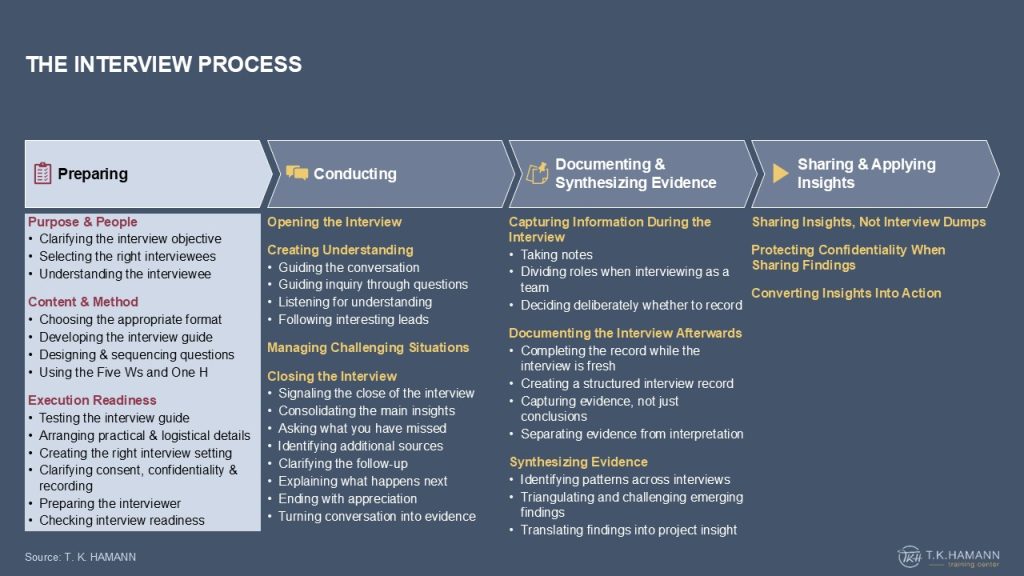
1 Purpose & People: What Do We Need to Learn—and From Whom?
Effective interview preparation begins with purpose and people. Before considering specific questions or the structure of the conversation, the project team must clarify what they want to learn and who can best provide the necessary knowledge and perspectives. This means defining a clear interview objective, deliberately selecting interviewees, and understanding the people behind their organizational roles. Making these decisions correctly provides the foundation for everything that follows.
1.1 Clarifying the Interview Objective: What Do We Need to Learn—and Why?
An interview objective is a clear statement of what the project team hopes to learn from a specific interview. It defines the purpose of the conversation before the specific questions are developed.
A weak interview objective might read: “Understand the production process.” A stronger objective would read: “Understand where production supervisors see the main causes of recurring line stoppages, how they currently respond to them, and which improvement ideas they consider realistic.” The difference matters. The first objective is too broad. It could lead to almost any question and answer. The second objective more precisely defines the desired outcome. It identifies the topic, perspective, and intended use of the information.
In business projects, interview objectives typically relate to the project’s core question or current hypotheses. A hypothesis is a preliminary explanation or answer that the project team tests through analysis and evidence. For example, a team investigating long order-to-cash cycle times might hypothesize that delays are primarily caused by incomplete customer master data. Then, interviews with Sales, Operations, Finance, and Customer Service can be designed to test whether this explanation is plausible, incomplete, or incorrect.
The best interview objectives are neither too narrow nor too broad. If they are too narrow, the interviewer may miss unexpected insights. If they are too broad, the conversation may drift. A useful test is to see if the objective can be translated into two, three, or four central questions that, if answered well, would significantly improve the team’s understanding of the problem.
The objective of an interview should specify what the project team wants to learn and what the interaction itself should accomplish. While gathering information is usually the primary purpose, interviews can also help build trust, understand the organizational context, identify barriers, test emerging ideas, and garner support for subsequent project work. The emphasis placed on each of these goals will vary by interviewee. For example, a subject-matter expert may primarily be a source of specialized knowledge, while an influential stakeholder may be equally important for understanding concerns and building alignment.
1.2 Selecting the Right Interviewees: Who Can Provide the Perspectives We Need?
Once the objective is clear, the next question is whom to interview. In many projects, teams make the mistake of only interviewing the most obvious candidates, such as senior managers, official process owners, or individuals recommended by the project sponsor. While these interviews are often necessary, they are rarely sufficient.
A good interview plan incorporates various perspectives. For instance, senior executives understand strategic priorities and political constraints. Middle managers understand resource limitations and cross-functional dependencies. Frontline employees know how work is done. Customers may reveal pain points that internal teams have normalized. Suppliers may identify inefficiencies that the buying organization no longer notices. External experts can provide benchmarks and challenge internal assumptions.
The goal is not to interview everyone. Rather, the goal is to interview people whose perspectives are most relevant to the problem. This requires judgment. For instance, a project team investigating declining service quality should speak with more than just the head of Customer Service. They should also interview call center agents, complaint handlers, select customers, sales managers, and IT Support, if applicable.
The selection of interviewees should reflect the importance of implementation. While some interviewees may not have unique factual knowledge, they will influence the solution’s success later. Speaking with these individuals early on can reveal concerns, constraints, and possible sources of resistance. In this sense, interviews support analysis and stakeholder alignment.
A stakeholder is anyone who can affect, is affected by, or perceives themselves as being affected by a project or decision. In interviews, stakeholders are more than just sources of information. They are often future users, implementers, supporters, critics, or decision-makers. Therefore, treating them only as data providers is too narrow.
1.3 Understanding the Interviewee: What Should We Know About the Person Before the Meeting?
Before conducting an interview, the interviewer should learn enough about the interviewee to ensure a credible and respectful conversation. This does not require excessive research. However, it does require basic preparation. At a minimum, the interviewer should understand the interviewee’s role, organizational unit, relationship to the project, and any potential sensitivities. For instance, interviewing the CFO about margin erosion differs from interviewing a plant supervisor about machine downtime. Interviewing a customer who recently filed a complaint is different from interviewing a loyal customer who has used the company’s services for ten years.
This preparation helps the interviewer adjust their tone, language, and sequence. It also helps avoid unnecessary mistakes. For instance, asking a senior executive basic questions that could have been answered by reading the annual report may suggest poor preparation. Similarly, asking a frontline employee to comment on corporate strategy may make them uncomfortable. Starting the interview with the question, “What exactly do you contribute to the restructuring project?” may make the interviewee defensive before the real interview has even begun.
The interviewer should consider the interviewee’s agenda. An agenda is a person’s set of interests, concerns, objectives, or desired outcomes in each situation. Every interviewee has an agenda. Some want to help the project succeed. Others want to protect their department. Some want to make sure their frustrations are finally heard. Some want to influence the project team’s conclusions. None of this is unusual. It is all part of organizational life.
Good interviewers do not become cynical about agendas; rather, they remain aware of them. They listen respectfully, asking themselves how the interviewee’s position, incentives, and experience may influence what is being said.
Preparing for an interview also means looking at it from the interviewee’s perspective. Ask yourself what the interviewee knows about the project, what he or she expects from the conversation, what information he or she may be reluctant or unable to disclose, and what concerns the interview may create. In transformation, restructuring, or performance-improvement projects, a seemingly simple request for information can be interpreted in many ways by the person receiving it. Anticipating these perceptions allows the interviewer to frame the conversation appropriately, address potential concerns, and establish an environment conducive to open and productive communication.
2 Content & Method: How Should We Structure the Inquiry to Generate Useful Evidence?
Once the purpose and interviewees are clear, the focus turns to designing the inquiry itself. The interviewer must decide on an appropriate level of structure, the topics to be covered, how to formulate questions, and the order in which to explore them. The goal is to create enough structure to keep the conversation purposeful while preserving the flexibility to follow unexpected insights, without scripting it in advance. Thus, a well-designed interview provides direction without constraining discovery.
2.1 Choosing the Appropriate Interview Format: What Degree of Structure Does the Interview Require?
The format of an interview should align with the investigation’s purpose.
A structured interview is appropriate when the team needs consistent responses from multiple respondents. This type of interview is useful when the project requires consistency, quantification, or simple classification. For instance, a project team might conduct structured interviews with thirty branch managers to determine which of five operating procedures each branch currently uses.
A semi-structured interview is appropriate when the team knows the main topics but expects the details to differ from person to person. This format is the most common in project work. It allows the interviewer to cover the same core themes across multiple conversations while probing for details. For instance, a transformation team might interview several department heads using the same general topics, such as current pain points, decision bottlenecks, resource constraints, and improvement ideas, but ask different follow-up questions for each department.
An unstructured interview is useful when the topic is poorly understood, and the team wants to explore it before forming hypotheses. Before designing a new customer experience initiative, for instance, a team might have open conversations with select customers to understand how they perceive the company, what frustrates them, and what they value most.
Most project interviews should be semi-structured. They provide enough consistency to generate comparable insights while allowing enough flexibility to discover information the team did not anticipate.
2.2 Developing the Interview Guide: What Do We Need to Cover to Achieve the Interview Objective?
An interview guide outlines the topics and questions the interviewer intends to cover. It is not a script that must be followed mechanically. Rather, it is a flexible yet disciplined tool. It helps interviewers stay focused while allowing the conversation to develop naturally. A useful interview guide typically includes five elements:
- It states the objective of the interview. This reminds the interviewer why the conversation is important.
- It identifies the two, three, or four most important topics to cover. A common mistake is preparing too many topics. If the interview is only thirty or forty-five minutes long, the interviewer cannot possibly cover everything. Therefore, the guide should distinguish between what is essential and what is merely nice to know.
- It translates each topic into questions. These questions should be clear, simple, and relevant. Complicated, long questions often confuse interviewees and reveal that interviewers have not clarified their own thinking.
- The guide includes possible follow-up prompts. Examples include: “Can you give me an example?”, “What happened next?”, “How often does this occur?”, “Who else is involved?”, and “What makes this difficult?” These types of follow-up questions often produce more useful information than the original question.
- The guide includes a closing question. One of the most valuable is: “Is there anything important that I haven’t asked you?” This question is effective because the interviewee usually knows the context better than the interviewer does. It gives them an opportunity to bring up issues that the project team may not have considered yet. Sometimes the answer will be brief. Occasionally, however, it will be the most important answer of the entire interview.
2.3 Designing Better Questions: How Should We Ask to Obtain Relevant and Unbiased Answers?
Good questions are essential to a good interview. A question is not good just because it sounds sophisticated. Rather, a question is good when it helps the interviewer learn something relevant, accurate, and useful.
Open-ended questions invite explanation. It cannot be answered with a simple “yes” or “no.” For example: “What are the main reasons orders are delayed after customer approval?” This question encourages the interviewee to describe the causes, context, and relationships involved.
In contrast, a closed question asks for a specific answer, often a “yes” or “no,” a number, or a choice among alternatives. For example: “Do you review every order manually before release?” Closed questions are not inferior. They are useful when the interviewer needs confirmation, precision, or a certain fact. However, the danger arises when the entire interview consists of closed questions. The conversation then becomes narrow and mechanical.
A probing question follows up on an answer to obtain more detail. For example: “You mentioned that approval rules differ by customer segment. Can you explain how they differ?” Probing questions are often where the real learning occurs. They demonstrate to the interviewee that the interviewer is engaged and that the conversation is not merely following a checklist.
A leading question suggests the answer the interviewer expects or wants to hear. For example: “Would you agree that the main problem is poor communication between Sales and Operations?” This type of question may bias the response. A better version would be: “How would you describe the communication between Sales and Operations?” The difference is subtle but important. The first question pushes the interviewee toward the interviewer’s hypothesis. The second allows the interviewee to describe the situation in his or her own words.
Question quality is especially important in semi-structured interviews. Since interviewers have flexibility, there is always a risk of unintentionally steering the conversation toward a desired outcome. Therefore, interviewers should ask brief, neutral, and easy-to-understand questions.
One helpful principle is to first ask about concrete experiences before asking for interpretations. Instead of asking, “Why is the process inefficient?” the interviewer could ask, “Can you walk me through what happens after a customer submits a change request?” Only after the interviewee has described the experience should the interviewer ask why the process works the way it does. This sequence reduces defensiveness and produces richer answers.
2.4 Sequencing Questions: How Should the Conversation Move Between Exploration and Evidence?
The quality of an interview depends on more than just the questions asked; the order in which they are asked is also important. Question sequencing is the deliberate arrangement of questions so that the conversation develops logically, supports the interviewee’s thinking, and progressively generates the necessary information. Instead of treating the interview guide as a list of independent questions, effective interviewers consider how one question prepares the ground for the next.
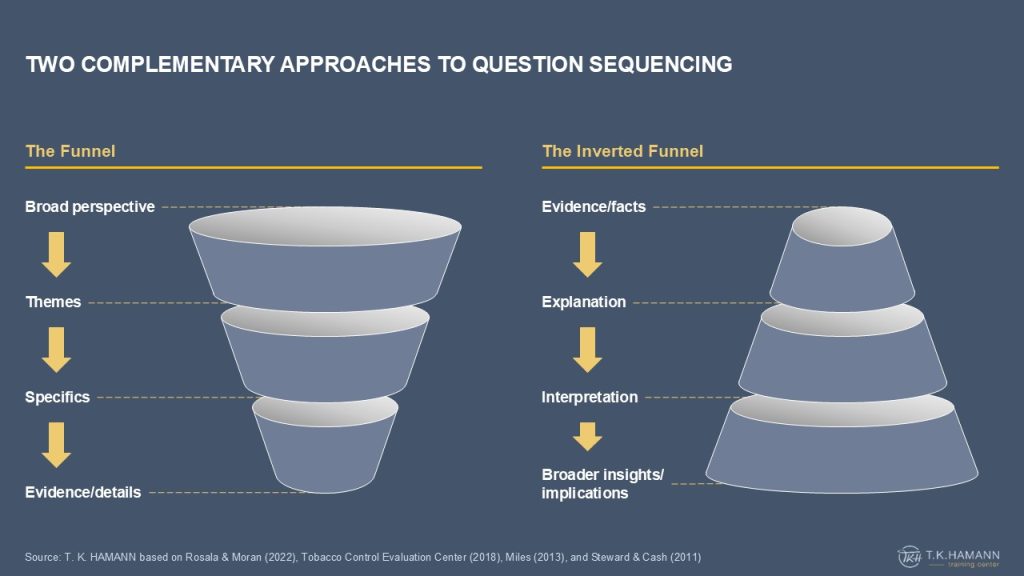
One useful approach is the funnel sequence, which starts with broad, open questions and moves toward increasingly specific ones. The interviewer may begin by inviting the interviewee to describe a situation in his or her own terms and then narrow the discussion to specific themes, examples, facts, and supporting evidence. For instance, an interview about delivery performance could start with, “How would you describe the main challenges affecting delivery reliability?” Once the interviewee identifies supplier performance as an important issue, the interviewer can narrow the focus progressively: “Which suppliers are causing the greatest difficulties?”, “What kinds of problems occur most frequently?”, and eventually, “How often did these problems result in delayed deliveries during the last quarter?” This sequence has an important advantage in that it allows the interviewee’s perspective to emerge before the interviewer imposes too much structure on the conversation. Broad questions can reveal issues that the project team had not anticipated, while subsequent probing converts general observations into more specific, verifiable information. In simplified terms, the funnel moves from perspective to themes, from themes to specifics, and from specifics to evidence.
However, not every interview—or every topic within an interview—should follow this sequence. Sometimes, the project team already has specific facts or observations and wants to understand their meaning. In such cases, an inverted funnel sequence can be more effective. In this case, the interviewer begins with something concrete and broadens the conversation progressively toward interpretation, implications, and conclusions. The additional source on high-value interviews distinguishes this approach from the conventional funnel and suggests its usefulness when an interviewee is initially reluctant to address a broad issue or when starting with known facts helps them develop a broader perspective. For example, suppose an analysis established that a company reduced its supplier base from 42 to 27 during the previous year. The interviewer could start by asking about that observation and follow up with questions about what drove the reduction, what effects it produced, and what the organization learned from the experience. The conversation can then broaden further: “What does that experience tell us about the supplier strategy going forward?” The sequence moves from evidence to explanation, then to interpretation, and finally to broader insight.
Exhibit 2 illustrates these two complementary approaches to question sequencing. The funnel approach moves from broad perspectives toward increasingly specific evidence. It is useful when the interviewer wants to explore how the interviewee sees a situation before narrowing the discussion. The inverted funnel starts with specific facts or observations, opening the conversation to interpretation and implications. Neither sequence is inherently superior. Their usefulness depends on what is already known, what the interview aims to uncover, and how easily the interviewee can engage with the topic.
Importantly, these two approaches do not have to define an entire interview. Skilled interviewers may switch between them as the conversation progresses. For example, a broad funnel may reveal an unexpected issue. The interviewer can then explore that issue in detail, establish specific facts, and subsequently broaden the conversation again to understand its implications. Thus, question sequencing is not a rigid script, but rather a way of giving purposeful structure to a guided dialogue while preserving the flexibility to follow the evidence. This is particularly important in hypothesis-driven problem solving. While existing hypotheses may suggest where an interviewer should probe and which evidence matters, they should not determine what the interviewee is allowed to reveal. The sequence of questions should help the interviewer continuously move between exploration and validation, using emerging evidence to refine, challenge, or expand the team’s understanding of the problem. In this sense, effective question sequencing reflects the same iterative logic that underpins the Eight Steps for Solving Problems: Structure provides direction while new evidence determines the next step in the inquiry.
2.5 Using the Five Ws and One H: Which Simple Questions Help Us Make Vague Answers Concrete?
One simple way to improve your questioning skills is to use the classic journalistic structure of the five Ws and one H—who, what, where, when, why, and how.
In business interviews, these questions help interviewers understand what happened. For example, suppose a manager complains that the approval process takes too long. The interviewer could then ask:
- “Who is involved in the approval process?”
- “What information is required?”
- “Where does the request get stuck?”
- “When do delays usually occur?”
- “How is the decision documented?”
- “Why is the approval required in the first place?”
The sequence matters. Asking “why” too early can make people defensive, especially when the topic involves errors, conflicts, or performance problems. They may feel as if they are being asked to justify themselves. It is often better to first understand the factual situation and then ask for explanations.
3 Execution Readiness: How Do We Ensure That Everyone and Everything Is Ready for the Conversation?
Even a well-designed interview can fail if it is not properly prepared. Before the interview begins, the interviewer should ensure that the interview guide works as intended, make the necessary practical arrangements, prepare the interviewee, create a setting conducive to open communication, and clarify relevant ground rules concerning consent, confidentiality, and recording. Finally, the interviewer must be ready to listen with curiosity, adapt to the conversation, and challenge their own assumptions. Execution readiness transforms a sound interview design into the conditions necessary for a productive professional conversation.
3.1 Testing the Interview Guide: Will the Guide Work as Intended?
Before using an interview guide for important conversations, the team should test it. A pilot test is a small-scale trial of an interview guide, questionnaire, or other data collection instrument. The purpose of a pilot test is to ensure that the instrument works as intended before it is used more broadly.
For business projects, pilot testing does not need to be elaborate. For instance, an interviewer could test the guide with a colleague, an internal expert, or the first interviewee in a less sensitive setting. This allows them to identify unclear questions, unrealistic timing, missing topics, or confusing wording.
Pilot testing is particularly useful when several team members will conduct interviews. Without a shared understanding of the guide, different interviewers may ask questions in very different ways, generating findings that are difficult to compare. A short rehearsal can significantly improve consistency. For instance, a team preparing interviews with plant managers might discover during a pilot interview that different people interpret the phrase “operational flexibility” differently. One manager may interpret it as labor flexibility, another as machine flexibility, and a third as the ability to change production schedules. Clarifying the wording before the full interview program begins can prevent such misunderstandings and improve data quality.
3.2 Arranging Practical and Logistical Details: What Needs to Be Organized Before the Interview Can Begin?
After preparing the content of the interview, the practical arrangements must be made. While these details may seem administrative, poor logistics can easily undermine an otherwise well-designed interview. Late invitations, unclear locations, missing access credentials, insufficient time, and technical problems can distract the interviewer and interviewee before the substantive conversation has even begun.
The first consideration is timing. The interview should be scheduled for a duration that matches its objective and level of complexity. For many business interviews, 30 to 60 minutes is sufficient, although particularly complex or senior-level discussions may require a different format. The calendar invitation should clearly state the purpose, duration, location, and connection details. Where appropriate, it should also state the main topics to be discussed. If multiple interviewers will participate, their respective roles should be agreed upon in advance to avoid overwhelming the interviewee with an unnecessarily large or disorganized group.
For in-person interviews, practical preparations include confirming the meeting room, arranging access to the site, setting up visitor registration, addressing security requirements, and ensuring that any necessary equipment is available during the discussion. If the interview is connected to an operational process, the team may also need to arrange access to the relevant workplace, production area, system, or documentation. Remote interviews require a different set of checks. The video conferencing platform should be agreed upon in advance. Links should work, access rights should be tested, and the interviewer should ensure that the audio, camera, headset, and internet connection are reliable. A backup contact method is useful for important discussions or those involving external participants.
The interviewer should also prepare any materials needed during the interview. These may include the interview guide, relevant background documents, selected analyses or exhibits, note-taking materials, and any information that needs to be shown to the interviewee. However, these materials should support the conversation rather than dominate it. Opening several documents or searching for files during the interview can interrupt the flow and signal poor preparation.
Documentation requirements should also be considered as part of the logistics. The team should know in advance who will take notes, where those notes will be stored, whether a recording will be made, and what follow-up information will need to be collected after the interview. Section 2.3.5 discusses the substantive rules regarding consent, confidentiality, and recording. At this stage, the practical objective is simply to ensure that the agreed-upon documentation approach can be implemented.
Finally, the interviewer should schedule enough time between important interviews. Although scheduling conversations back-to-back may appear efficient, it leaves little time to review notes, capture immediate impressions, or prepare mentally for the next interview. Even a short buffer can improve both documentation quality and interviewer focus.
Practical preparation therefore serves a simple purpose. To remove avoidable friction before the conversation begins. When the timing, access, technology, materials, roles, and documentation arrangements are clear, the interviewer and interviewee can focus on the interview’s substantive objective rather than preventable logistical distractions.
3.3 Preparing the Interviewee: What Does the Interviewee Need from Us Before the Meeting to Be Appropriately Prepared?
In many cases, it is best for the interviewee to receive an advance explanation of the interview’s purpose and the main topics to be covered. This approach is practical and courteous. It allows interviewees to prepare, gather relevant information, and understand why the conversation matters.
However, the level of detail provided should depend on the situation. In most business projects, sharing the broad topics is helpful. For example: “We would like to understand the current order approval process, typical sources of delay, and your ideas for improvement.” This prepares the interviewee without turning the conversation into a scripted presentation. In politically sensitive situations, the team may choose not to share detailed questions in advance. If there is a risk that interviewees will coordinate their answers, hide information, or become defensive, the interviewer may only provide a general description of the purpose. In any case, the interviewee should not feel ambushed. Being transparent about the general reason for the conversation is essential to professional interviewing, even when not every question is disclosed beforehand.
3.4 Creating the Right Interview Setting: Where and Under What Conditions Can an Open Conversation Take Place?
The setting influences what people are willing to say. For instance, a hurried conversation in a noisy hallway seldom provides the same level of insight as a scheduled discussion in a quiet room. Therefore, interviewers should consider location, timing, confidentiality, and comfort level.
The interview should take place where the interviewee can focus and speak freely. For sensitive topics, privacy is important. If the interview concerns operational work, conducting it close to the actual process may be useful. For example, it could take place in a production area, service center, store, or customer environment. This setting can trigger concrete examples and allow the interviewee to demonstrate how work is done.
The interviewer’s appearance should fit the situation as well. The goal is not to impress, but rather to appear credible without creating distance. In some environments, a dark suit signals professionalism. In others, it creates unnecessary hierarchy. The interviewer should adapt to the context while remaining authentic.
Finally, the interviewer should clarify the practical arrangements:
- How long will the interview take?
- Will it be in person or remote?
- Will anyone else be present?
- Can the conversation be recorded?
- Should the interviewee prepare any documents or examples?
Although these details may seem administrative, they affect the quality of the discussion.
3.5 Clarifying Consent, Confidentiality, and Recording: What Ground Rules Need to Be Established?
Some interviews may touch on sensitive topics, such as performance problems, leadership conflicts, organizational redesign, cost reduction, customer complaints, and failed projects. In such situations, interviewees may be concerned about how their comments will be used. Therefore, the interviewer should clarify the ground rules.
Consent means that the interviewee understands the purpose of the conversation and agrees to participate. In most business settings, consent does not require a formal legal document; however, it does require openness about the nature of the discussion. If the interview will be recorded, permission should be requested explicitly.
Confidentiality means that information shared during the interview will be kept private and used only within defined boundaries. In practice, confidentiality can take different forms. Sometimes, the interviewer can promise that comments will not be attributed to the interviewee by name. Sometimes, due to governance or legal requirements, such a promise is impossible to make. The important thing is to be clear and honest.
Interviewers should never promise confidentiality that they cannot uphold. While this may initially encourage openness, it can destroy trust in the long run. A better approach is to explain how the information will be used. For example: “We will synthesize findings across interviews and report themes rather than attributing individual statements, unless we ask for your permission to quote something directly.”
Recording can improve accuracy, especially in research-heavy work. However, recording may also make interviewees cautious. When establishing trust is more important than creating a verbatim transcript, taking notes may be preferable. When accuracy is critical or when the interviews will be analyzed in depth, recording may be appropriate. The decision should reflect the needs of the project and the comfort level of the interviewee.
3.6 Preparing the Interviewer: Am I Ready to Listen, Learn, and Challenge my Own Assumptions?
Finally, the interviewer must prepare personally. This means reviewing the objective, familiarizing themselves with the guide, anticipating potential issues, and entering the conversation with the right mindset.
The right mindset combines curiosity, discipline, and humility. Curiosity encourages the interviewer to learn rather than merely confirm existing beliefs. Discipline keeps the conversation focused on the project’s needs. Humility reminds the interviewer that the interviewee often knows more about the practical reality of the topic than the project team does.
This last point is especially important. Project teams are often under pressure to produce quick conclusions. As a result, they may enter interviews with strong hypotheses and unconsciously search for confirmation. Confirmation bias is the tendency to notice, interpret, or favor information that supports one’s existing beliefs. In interviews, this bias can be dangerous because the interviewer may only hear what fits the emerging storyline. Good preparation therefore includes preparing to be surprised. While interviewers should be familiar with the hypotheses, they should not be trapped by them. Some of the best interviews force the team to reconsider its initial assumptions.
3.7 Checking Interview Readiness: Are We Well Prepared to Conduct the Interview?
Good preparation does not result in a thick interview manual. It is clarity. By the time the interviewer enters the meeting room, he or she should be able to answer these six questions:
- “What do we need to learn?”
- “Why is this interviewee relevant?”
- “What are the two to four most important topics?”
- “Which questions will help us explore these topics?”
- “What sensitivities should we anticipate?”
- “How will we document and use the findings?”
If we cannot answer these questions, the interview is not ready.
Preparation is not bureaucracy. It is the first act of professional respect toward the interviewee and the first act of analytical discipline toward the problem.
References
Miles EW (2013) Developing strategies for asking questions in negotiation. Negotiation Journal 29(4):383–412.
Rosala M, Moran K (2022) The funnel technique in qualitative user research. Accessed August 28, 2026, https://www.nngroup.com/articles/the-funnel-technique-in-qualitative-user-research/.
Steward CJ, Cash WB (2011) Interviewing: Principles and Practices (McGraw-Hill, New York).
Tobacco Control Evaluation Center (2018) Tips & tools #2: Creating interview questions. Tobacco Control Evaluation Center, University of California, Davis, CA.