
ACING INTERVIEWS I: Why Conversations Are a Critical Source of Business Evidence
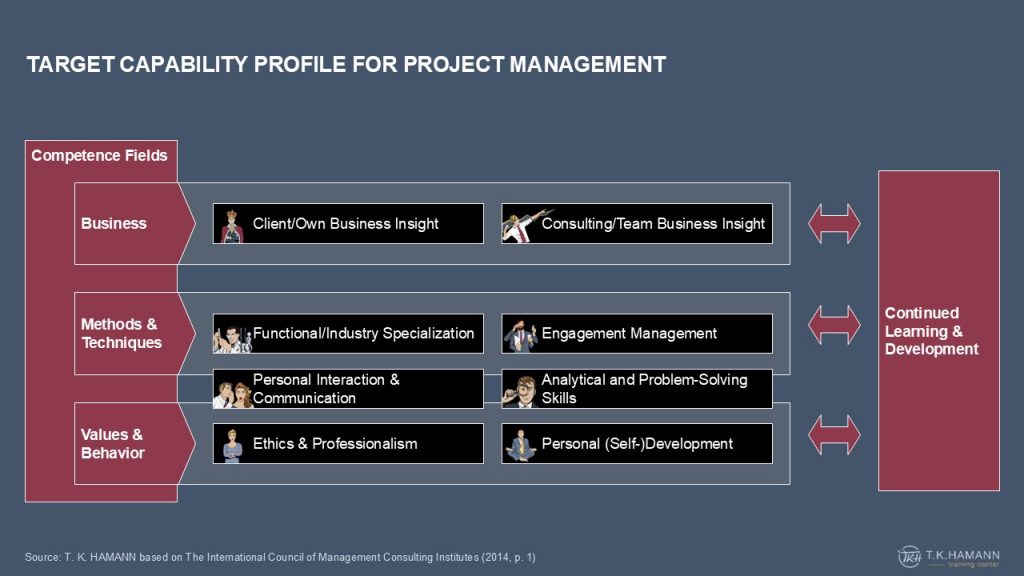
Interviewing primarily belongs to the Personal Interaction and Communication capability area of the Project Management Target Capability Profile (see Exhibit 1). This placement is deliberate. An interview is not just a research method, consulting technique, or meeting format. At its core, an interview is a deliberate human interaction in which one person seeks to understand what another person knows, has experienced, believes, fears, expects, or recommends.
At the same time, interviewing is closely connected to other elements of the Project Management Target Capability Profile. For example, it supports Analytical and Problem-Solving Skills because interviews are an important method of collecting data to solve complex business problems. Project teams may also analyze documents, evaluate quantitative data, observe processes, run workshops, conduct surveys, or test prototypes. Interviews complement these methods by providing access to tacit knowledge such as practical experience, informal routines, unspoken concerns, political realities, customer frustrations, implementation risks, and lessons learned from previous attempts. This knowledge often exists only in people’s heads.
Interviewing also requires Ethics and Professionalism. Interviewees may share sensitive information. They may feel exposed, uncertain, or even threatened by the project. They may wonder if their words will be used against them. Therefore, capable interviewers have a responsibility to create a respectful setting, explain the purpose of the conversation, clarify how information will be used, ask for permission before recording, protect confidentiality when necessary, and avoid using the interview as a form of pressure.
The following treats interviewing as a disciplined learning process. While a good business interview should not feel like a casual conversation, it also should not feel like an interrogation. It requires preparation, structure, active listening, good judgment, sensitivity, and follow-through. The interviewer must identify necessary information, select appropriate individuals, develop relevant questions, guide the discussion, record the findings, and convert insights into improved project decisions.
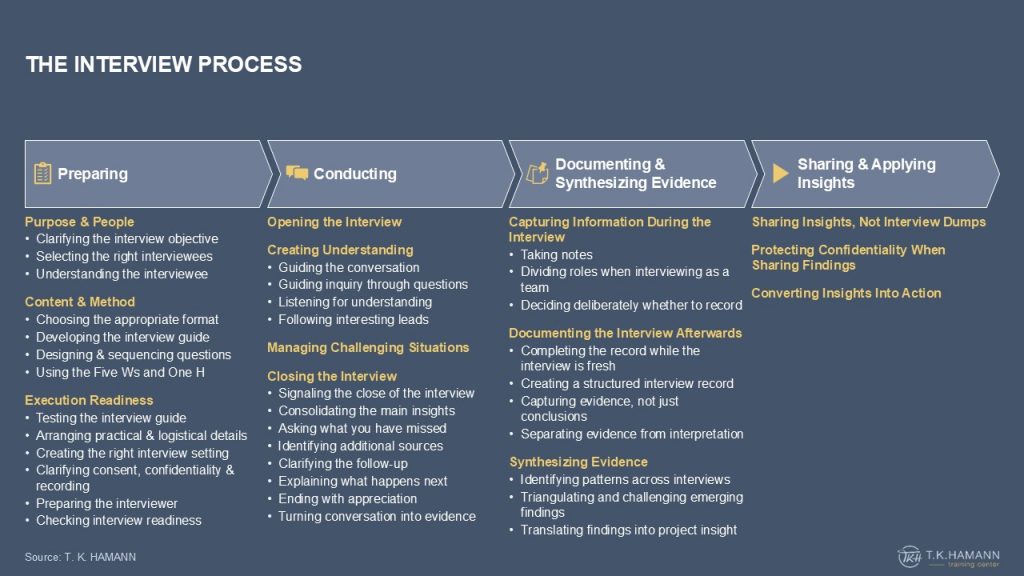
The interview process can be organized into four phases, as illustrated in Exhibit 2. These phases are Preparing, Conducting, Documenting and Synthesizing Evidence, and Sharing and Applying Insights. Each phase addresses a different core question. During the Preparing phase, the project team asks: “What do we need to learn, from whom, and how will we conduct the inquiry?” During the Conducting phase, the central question becomes: “How do we create understanding through the conversation?” During the Documenting and Synthesizing Evidence phase, the team asks: “What did we learn, how reliable is it, and what does the combined evidence tell us?” Finally, during the Sharing and Applying Insights phase, the question becomes, “How do we make that insight useful to the project and translate it into the next best step?” For clarity, Exhibit 2 presents these four phases as a linear sequence. In practice, however, professional interviewing is more iterative. Activities may overlap across phases. Documentation begins during the interview through note-taking. An unexpected answer can change the interviewer’s understanding of the problem immediately. Findings from earlier interviews can lead the project team to revise hypotheses, adapt the interview guide, or ask different questions in subsequent conversations. Likewise, synthesis may reveal gaps requiring additional interviews or other forms of evidence. Therefore, the four phases should be understood as a guiding structure rather than a rigid sequence. They provide orientation while allowing the interview process to evolve as new evidence changes what the project team needs to understand.
This process mirrors the broader logic of professional problem solving. In the Iterative Eight Steps for Solving Problems, interviews can help clarify the problem, test hypotheses, collect primary data, interpret findings, develop solutions, identify implementation barriers, build support, and document lessons learned. Although interviews are not the only data collection method, they are often one of the most powerful, especially when the problem is complex, the available data are incomplete, and the real explanation lies in how people experience the organization.
Understanding Business Interviews
Every business project begins with uncertainty. Initially, the team rarely has all the necessary information to understand the problem, identify its underlying causes, develop viable solutions, and implement lasting improvements. Instead, the project team gradually reduces uncertainty by collecting, analyzing, and interpreting information from various sources.
Some of this information already exists. Financial reports, for example, reveal historical performance. Process documentation describes official procedures. Enterprise systems contain operational data. Market studies summarize customer trends, while academic publications and industry reports provide external perspectives. Together, these sources are referred to as secondary data, which is information originally collected for another purpose. Secondary data is often an excellent place to start. It is readily available and relatively inexpensive to obtain. They also frequently provide valuable quantitative evidence. However, secondary data has limitations. While they usually describe what happened, they often fail to explain why it happened. For instance, a dashboard might show that customer complaints have increased by 25 percent, but it cannot explain why customers have become dissatisfied. Similarly, a process map may describe how work is supposed to flow through an organization, yet it rarely reflects how employees perform their work under real-world conditions.
To close these information gaps, project teams must collect primary data. Primary data are information collected specifically to address a business problem. Unlike secondary data, primary data is created during the project and reflects its specific questions, hypotheses, and objectives. One of the most important methods for generating primary data is conducting business interviews. These interviews allow project teams to access undocumented knowledge, such as practical experience, organizational routines, implementation barriers, customer expectations, and lessons learned from previous initiatives. Often, this knowledge exists only in the minds of employees, managers, customers, suppliers, and other stakeholders. For example, imagine a team investigating a decline in on-time delivery performance. The logistics system may indicate where the delays are occurring, and warehouse reports may quantify the extent of the problem. However, it is only through speaking with warehouse supervisors that the team would learn experienced employees routinely bypass a cumbersome approval procedure to keep shipments moving. This type of insight rarely appears in formal reports but can fundamentally change the team’s understanding of the problem.
Therefore, interviews should not be viewed as substitutes for quantitative analyses or document reviews. Rather, interviews complement these methods. Effective problem solving almost always combines multiple sources of evidence. Documents provide facts, quantitative analyses reveal patterns, observations demonstrate actual behavior, and interviews illuminate motivations, experiences, and relationships. The more these sources converge toward the same conclusion, the greater the confidence in the team’s findings.
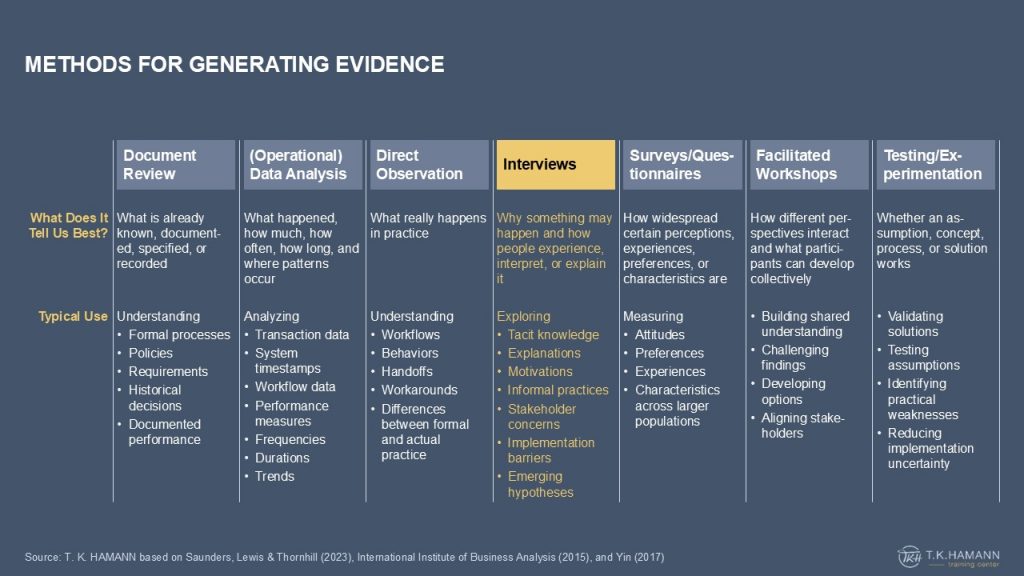
Project teams can use a variety of methods to collect evidence, each of which is useful for answering different types of questions. As Exhibit 3 shows, document review establishes what is already known or formally recorded; operational data analysis reveals measurable patterns and performance; direct observation shows what really happens in practice; and surveys determine how widespread certain perceptions or experiences are. Workshops are useful for bringing together different perspectives, and testing and experimentation help determine the effectiveness of assumptions, concepts, processes, or solutions. Interviews occupy a unique position in this system because they provide access to knowledge, experience, explanations, motivations, interpretations, informal practices, stakeholder concerns, and implementation barriers that may be inaccessible through other methods.
The choice of method should therefore follow the information need. For example, if the project needs to know how long a process takes, operational data may be more reliable than interview estimates. If the question concerns how work is performed, direct observation may be preferable. If the objective is to understand why people behave as they do, how they interpret a situation, or what tacit knowledge they possess, then interviews may be the most appropriate method. In practice, strong project evidence often emerges from combining several methods rather than relying on one method alone.
For this reason, experienced project managers do not usually ask if they should conduct interviews. Instead, they consider how interviews can best complement the other available information sources. A balanced evidence base is generally more robust than conclusions drawn from a single source.
1 Interviews as a Learning Process
Many inexperienced interviewers approach interviews as a series of questions that must be asked. However, experienced interviewers take a different perspective. Instead of just asking questions, they aim to learn as much as possible about a specific business aspect in a limited amount of time. From this perspective, interviewing becomes a disciplined learning process. Every question serves a purpose. Each answer is evaluated against the project’s current understanding of the problem. Each new insight either strengthens or challenges existing hypotheses, prompting the team to reconsider their thinking.
This learning process distinguishes business interviews from ordinary conversations. Conversations often develop without a specific destination. In contrast, business interviews have a clearly defined objective and are flexible enough to follow promising new insights as they emerge.
Consequently, successful interviewers must balance two seemingly contradictory requirements:
- They maintain enough structure to ensure the interview achieves its objective.
- At the same time, they should be curious enough to explore unexpected information, which may ultimately prove to be more valuable than the questions they had originally planned to ask.
The ability to find this balance is one of the defining characteristics of outstanding interviewers.
2 Different Types of Business Interviews
The purpose of the project and the type of information sought determine the form that business interviews will take. Three formats are particularly relevant for project work:
- In a structured interview, a set of standardized questions is asked in the same order to every interviewee. Since all participants receive the same questions, structured interviews allow for comparisons across larger groups of respondents. Structured interviews resemble verbally administered questionnaires and are useful for collecting standardized information from many individuals.
- A semi-structured interview combines structure with flexibility. Before the interview, the interviewer prepares a list of topics and key questions. However, the interviewer adapts the sequence, wording, and follow-up questions according to the interviewee’s responses. This format allows the interviewer to address unexpected issues while ensuring that the project’s objectives are met. It is the preferred format for consulting projects, transformation initiatives, and internal improvement efforts because it balances consistency and adaptability.
- An unstructured interview resembles an open conversation. Rather than following a predetermined guide, the interviewer encourages the interviewee to speak freely about a general topic. These interviews are valuable for exploratory work when little is known about the subject. However, conducting them effectively requires considerable interviewing experience.
For most business projects, semi-structured interviews are the most practical solution. They provide enough structure to support systematic problem-solving, yet they are flexible enough to uncover unexpected insights.
3 Interviews Throughout the Iterative Eight Steps for Solving Problems
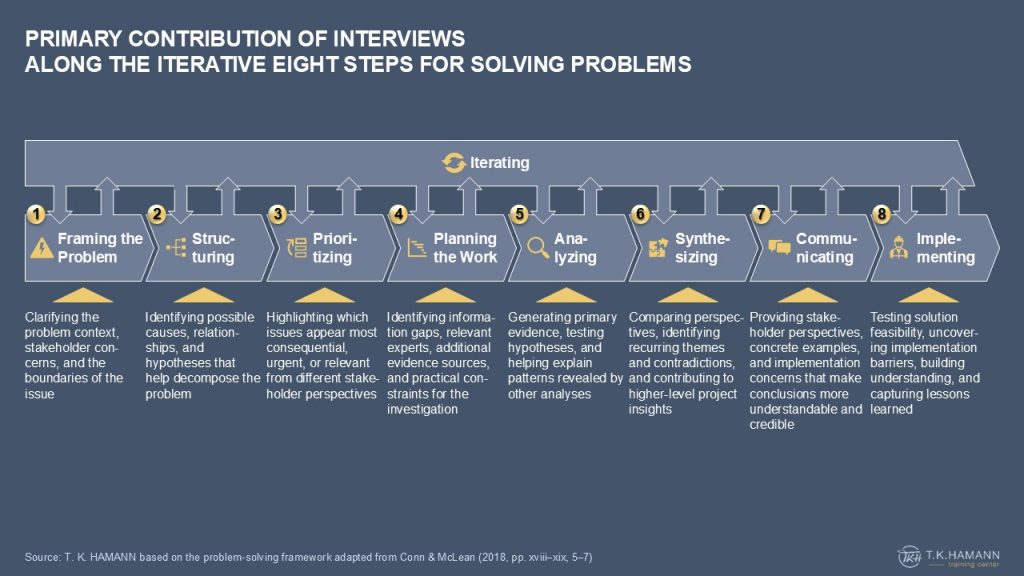
It is a common misconception that interviews are only used during the data collection phase of a project. In fact, they support almost every step of the problem-solving process. For example, at the beginning of a project, interviews can help clarify the nature of the problem, identify stakeholder concerns, and understand the organizational context. During the development of hypotheses, interviews provide an opportunity to challenge preliminary assumptions before investing substantial analytical effort. As the investigation progresses, interviews generate primary evidence that supplements quantitative analyses and document reviews. Later, when developing potential solutions, interviews help assess technical feasibility, organizational acceptance, implementation risks, and resource requirements. After implementation, interviews enable project teams to capture lessons learned and identify opportunities for continuous improvement. Therefore, interviewing should be regarded not as a single project activity but as a managerial capability supporting evidence-based decision-making throughout the Iterative Eight Steps for Solving Problems process.
Exhibit 4 illustrates how the contribution of interviews changes throughout the eight iterative steps for solving problems. During the Framing stage, interviews may help clarify the problem context and stakeholder concerns. During the Structuring stage, they may help identify possible causes and hypotheses. During the Prioritizing and Planning the Work stages, they may provide perspectives that inform decision-making. During the analyzing stage, interviews generate primary evidence, test hypotheses, and help explain patterns identified through other methods. As the project progresses, interviews contribute to synthesizing by revealing recurring themes, contradictions, and relationships across perspectives. During communicating, they provide concrete examples and stakeholder perspectives that make project conclusions more understandable and credible. Finally, during the Implementing stage, interviews help test the practical feasibility of solutions, identify barriers, build understanding, and capture lessons learned.
These contributions should not be interpreted as exclusive assignments of interview activities to individual steps. The problem-solving process is iterative, and the role of interviews evolves alongside the team’s information needs. For example, an interview conducted during the analysis phase may reveal an issue that requires the team to revisit the problem structure. Similarly, implementation interviews may expose assumptions that require further analysis, and lessons learned may influence how future problems are framed. Therefore, interviews move with the problem-solving process rather than belonging to a single step within it. We will take a closer look at these contributions later.
References
Conn C, McLean R (2018) Bulletproof Problem Solving (Wiley, Hoboken, NJ).
International Institute of Business Analysis (IIBA®) (2015) BABOK® v3: A Guide to the Business Analysis Body of Knowledge. Manual, IIBA, Toronto, Canada.
Saunders MNK, Lewis P, Thornhill A (2023) Research Methods for Business Students (Pearson, Harlow, United Kingdom).
The International Council of Management Consulting Institutes (ICMCI) (2014) CMC certification scheme manual: appendix 1 – CMC® competence framework. Manual, CMC-Global, ICMCI, Zurich, Switzerland.
Yin RK (2017) Case Study Research and Applications: Design and Methods (Sage, Thousand Oaks, CA).