Coping with an Unstructured World Through Structured Thinking We live in an age where complexity is the norm.  Problems no longer appear as isolated tasks with clear boundaries.  Instead, they span functions, time horizons, and stakeholder groups.  They evolve as …

Coping with an Unstructured World Through Structured Thinking Read more »

Building Project Leadership at Scale: Why a New, Capability‑Based Training Program Is Needed Now Although project work has become the dominant engine of value creation, too many initiatives still miss deadlines, exceed budgets, or fail to deliver promised benefits.  The …

Building Project Leadership at Scale: Why a New, Capability‑Based Training Program Is Needed Now Read more »

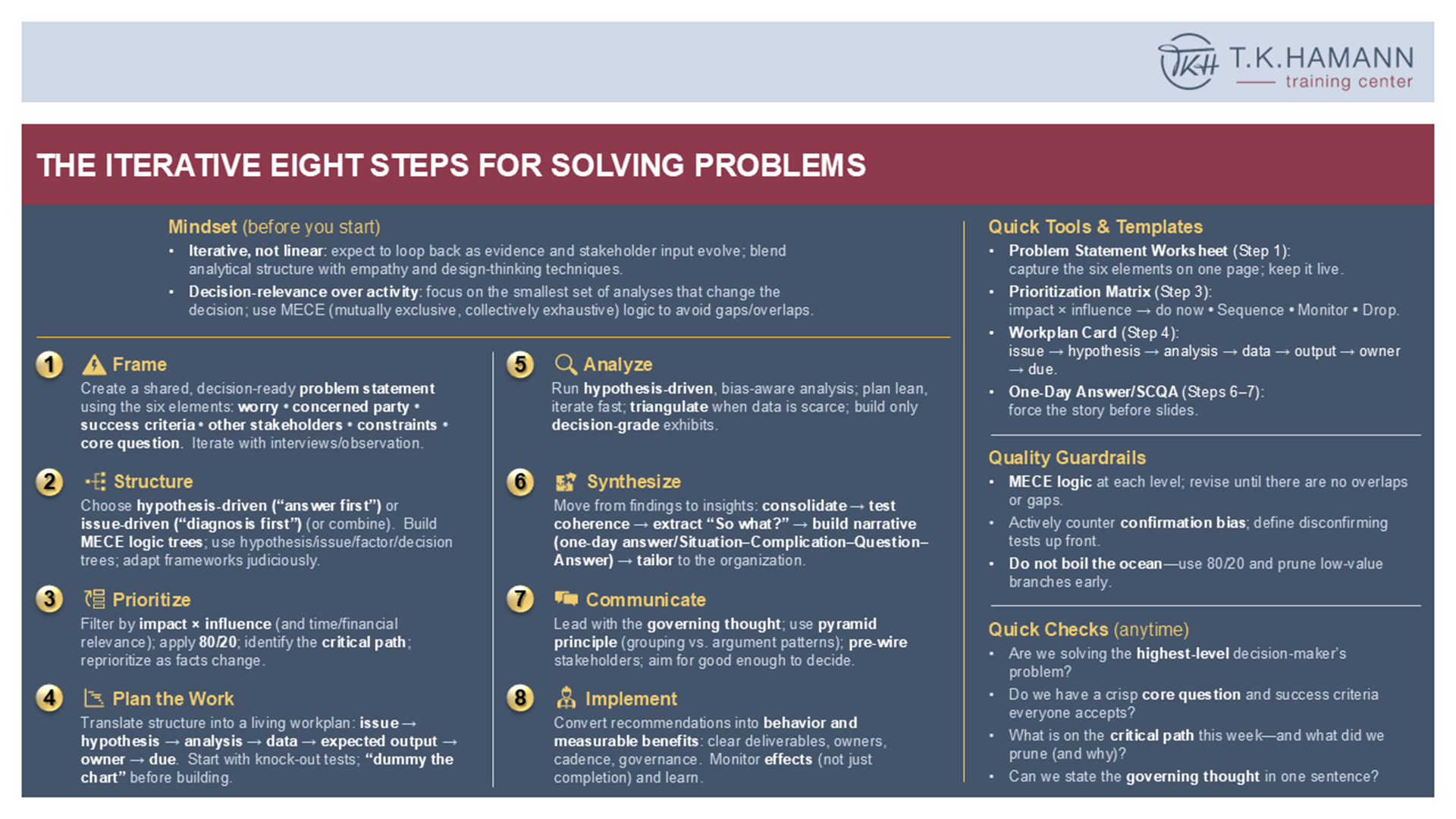
The Iterative Eight Steps for Solving Problems – Step 8: Implementing These elaborations build upon the Iterative Eight Steps framework developed in previous episodes of our newsletter and blog.  After diagnosing and analyzing the problem and designing a strategic solution, …

The Iterative Eight Steps for Solving Problems – Step 8: Implementing Read more »

The Iterative Eight Steps for Solving Problems – Step 7: Communicating 1. From Problem Solving to Selling the Solution Problem solving does not reach its decisive moment when the analysis is completed, but rather when the solution is convincingly communicated …

The Iterative Eight Steps for Solving Problems – Step 7: Communicating Read more »

The Iterative Eight Steps for Solving Problems – Step 6: Synthesizing In the Iterative Eight Steps for solving problems, synthesizing naturally follows the analytical work of step five (see Exhibit 1).  By this point, the problem has been carefully defined …

The Iterative Eight Steps for Solving Problems – Step 6: Synthesizing Read more »

The Iterative Eight Steps for Solving Problems – Step 5: Analyzing Analysis is the intellectual foundation of problem-solving.  It is where preparation meets evidence and intuition is tested against reality.  By the fifth step of the Iterative Eight Steps for …

The Iterative Eight Steps for Solving Problems – Step 5: Analyzing Read more »

The Iterative Eight Steps for Solving Problems – Step 4: Planning the Work In the first three steps of the Eight Iterative Steps for solving problems—framing the problem, structuring it, and prioritizing—an intellectual foundation was established.  This involved defining the …

The Iterative Eight Steps for Solving Problems – Step 4: Planning the Work Read more »

The Iterative Eight Steps for Solving Problems – Step 3: Prioritizing Prioritizing is the third step in the Iterative Eight Steps for Solving Problems (see Exhibit 1).  After framing and structuring a problem, teams often face a wide set of …

The Iterative Eight Steps for Solving Problems – Step 3: Prioritizing Read more »

The Iterative Eight Steps for Solving Problems – Step 2: Structuring 1. Why Structure Matters In today’s fast-paced, data-saturated business world, solving complex problems requires more than intuition and experience.  After carefully framing the problem by clarifying the situation, identifying …

The Iterative Eight Steps for Solving Problems – Step 2: Structuring Read more »